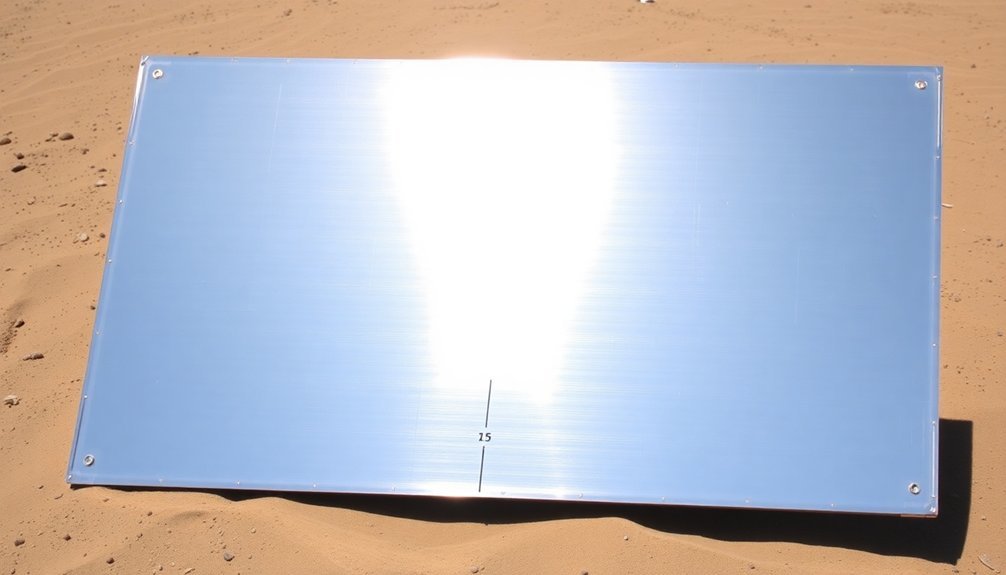
Place your reflectors at a distance that equals the parabola's focal length (calculated as f = 1/4a), while maintaining a 60-degree angle for peak energy concentration. You'll want to position them with a 15-degree angular tolerance to guarantee maximum cooking power, even during unattended cooking. For best results, adjust your reflectors seasonally – aim for a 75-degree tilt in summer and 80 degrees in winter. Remember to rotate them 10 degrees per hour to track the sun effectively. Keep a minimum 300mm horizontal clearance for safety. Understanding proper spacing and angles will dramatically boost your solar cooking efficiency.
Solar Cooker Spacing Fundamentals
When designing a solar cooker, understanding the reflector's positioning and angle is essential for peak performance. You'll want to position your reflectors at approximately 60 degrees if their length matches your target width. This angle guarantees ideal energy concentration during peak sunlight hours from 10:00 a.m. to 2:00 p.m.
You'll need to adjust your reflectors based on the sun's position throughout the day. The top reflector should be at a steeper angle, while the bottom one needs a shallower angle during low sun positions. Simply increasing reflector length without adjusting the angle will not improve the capture area significantly.
For maximum efficiency, make your cooker longer in the east/west dimension. This design choice helps you better utilize the reflectors as the sun moves across the sky and reduces the frequency of repositioning, particularly in temperate regions.
Optimal Distance Calculations
Building on proper reflector angles, calculating the ideal distance between your reflector and cooker requires precise mathematical consideration.
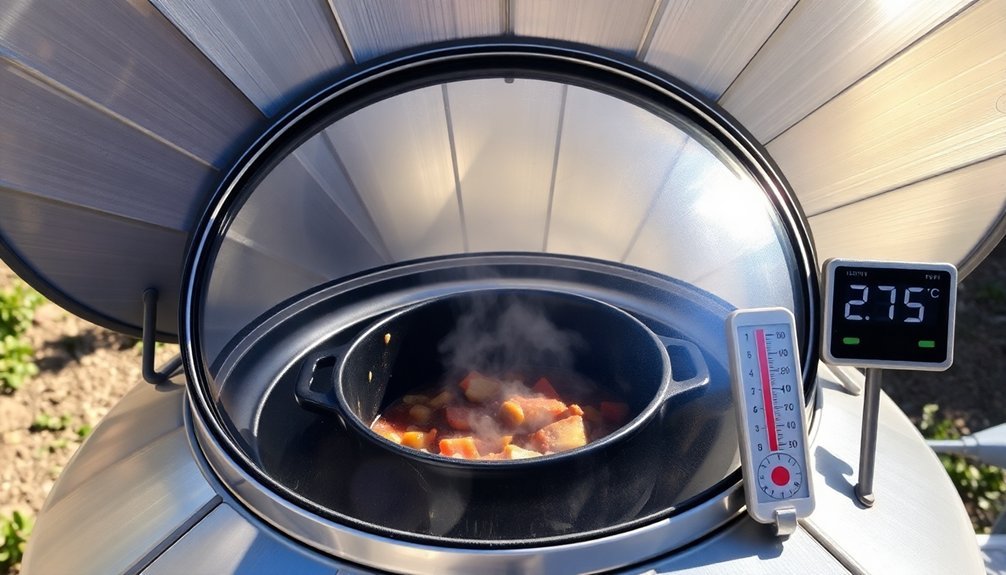
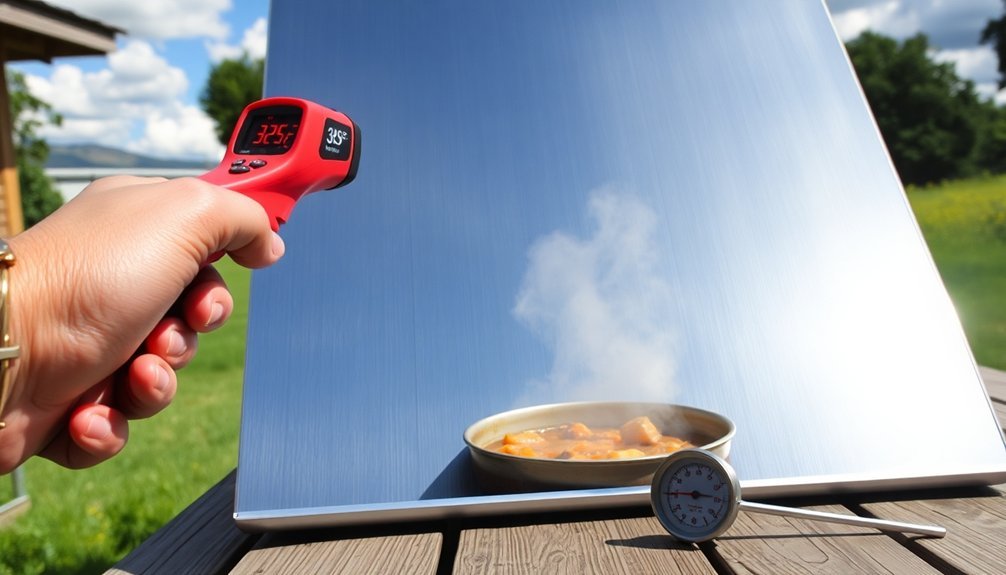
You'll need to refine your setup based on the reflector's size, shape, and the sun's movement pattern between 10:00 a.m. and 2:00 p.m. The key is maintaining a 15° angular tolerance while maximizing cooking power. Maximum temperatures exceed 400°F when reflectors are properly positioned on clear days with optimal distance settings.
- Position reflectors to align one hour ahead of the sun's movement, reducing required angular tolerance from 30° to 15°
- Consider your cooking pot's size and depth when determining suitable distance
- Account for flux collection efficiency, which varies with sun altitude (38% at 50° angle, 17.7% at 80° angle)
- Confirm all reflected rays hit either the transparent cover or cooking pot
- Calculate rim location using Cartesian coordinates to maximize solar flux capture within acceptable angular span
Reflector Angle and Position

Proper reflector angle and positioning serve as the foundation for efficient solar cooking performance.
You'll need to adjust your reflector's tilt angle seasonally – about 75° in summer and 80° in winter. For ideal sun tracking, rotate your reflector approximately 10° per hour, positioning it 20° East towards South in the morning and 20° West towards South in the afternoon.
Similar to how astronomical mounts require tracking limits, reflector adjustments help prevent shadowing and maintain optimal performance throughout the day. If you're using a fixed position, face your reflector towards the sun at noon. For more efficiency, consider twice-daily adjustments. Your reflector should maintain a ±15° angular tolerance for best results.
A hinged mounting system makes these adjustments easier, while adding counterbalances helps stabilize against wind. Remember, your reflector's effectiveness varies with seasons – proper orientation can boost energy gain by 50% during summer months.
Performance Based Distance Guidelines
Beyond reflector angles, the precise distance between your reflector and cooker directly impacts cooking performance.
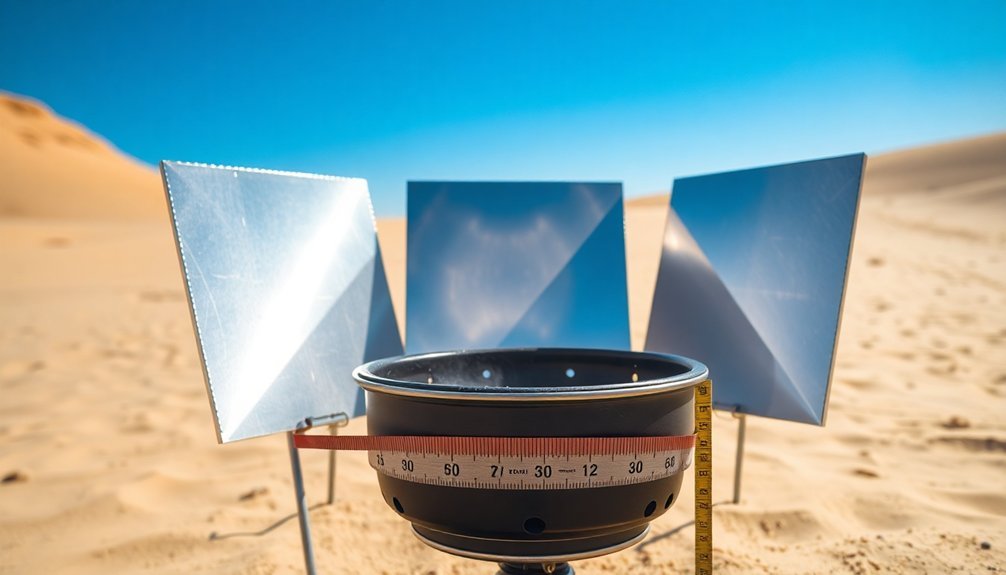
You'll need to position your reflector at a distance that equals the focal length of your parabola, which you can calculate using the formula f = 1/4a. For example, when a = 0.004, you'll want a distance of 62 cm.
- Position reflector to direct rim reflections toward cookware's center
- Verify setup allows for ±15° angular tolerance for two-hour unattended cooking
- Place reflector to "cuddle around" cookware for maximum efficiency
- Adjust distance to maintain uniform heating across your cooking surface
- Consider your pot's depth and color when finalizing placement
Safety and Maintenance Spacing

Safety gaps form the cornerstone of cooker installation, with electrical components requiring specific minimum distances to prevent accidents and damage.
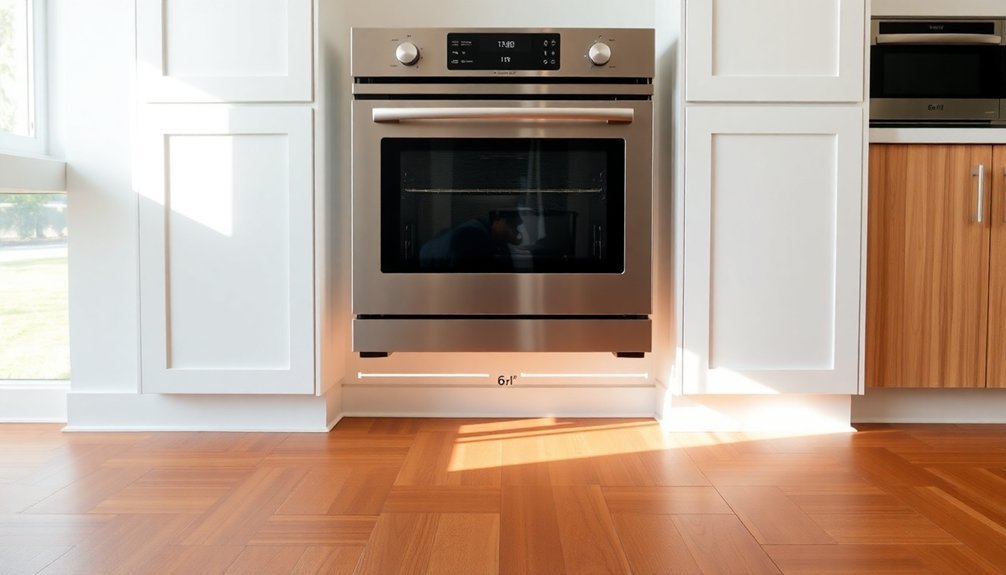
You'll need to maintain at least 300mm of horizontal space between your cooker's hob and any electrical switches or sockets, though 100mm is the absolute minimum in tight spaces.
Don't place electrical accessories directly behind or above the hob, as you'll risk burns from reaching over hot surfaces.
For maintenance and safety, you should guarantee your electrical components stay dry and protected from heat damage.
If you're installing a solar cooker, you'll need different spacing considerations – position it on level ground away from flammable materials, and secure it against wind.
When not in use, keep the reflector mirror facing downward to protect it from weather and prevent accidents.
Frequently Asked Questions
How Does Altitude Affect the Optimal Distance Between Reflectors and Cookers?
At higher altitudes, you'll need to place your reflectors closer to the cooker since there's less atmospheric interference. This maximizes energy concentration and takes advantage of the more intense solar radiation available.
Can Multiple Reflectors Be Stacked Vertically to Increase Cooking Power?
Yes, you can stack reflectors vertically to boost cooking power, but you'll need to carefully angle each layer to avoid shadows. Keep gaps between reflectors and adjust them regularly as the sun moves.
Do Different Cooking Vessel Materials Require Varying Reflector Distances?
Yes, you'll need to adjust reflector distances based on your cookware material. Dark pots allow more flexibility in positioning, while shiny vessels require more precise distances to maintain ideal heat concentration and efficiency.
How Does Humidity Impact the Ideal Spacing of Reflectors?
You'll need to position your reflectors slightly farther in high humidity, as moisture can scatter light. While standard spacing works in dry conditions, add 10-15% more distance when it's humid for ideal performance.
What's the Minimum Distance Needed Between Multiple Solar Cookers Operating Simultaneously?
You'll need to keep your solar cookers at least 3-6 feet apart to prevent shadow interference. This spacing guarantees each cooker works independently and maintains ideal sunlight capture without affecting neighboring units.
In Summary
You'll want to position reflectors 6-12 inches from your solar cooker for ideal performance, adjusting based on your specific model and sunlight conditions. Keep them close enough to concentrate light effectively but far enough to prevent overheating. Remember to check your cooker's manual for exact specifications, and always maintain proper spacing to guarantee safe operation and maximum cooking efficiency.

Leave a Reply