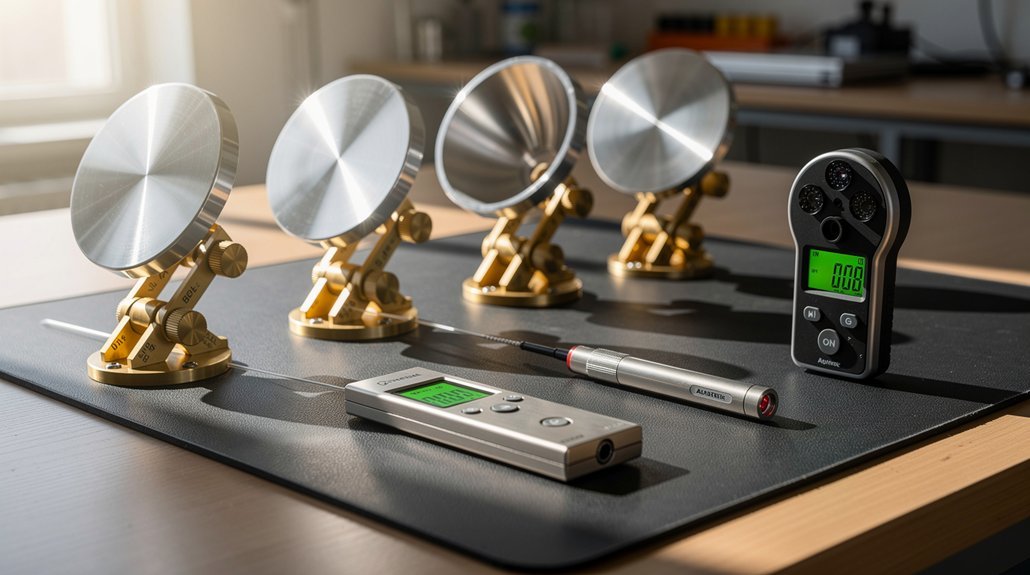
When you're cooking meat in a solar oven, you'll need to adjust your temperature targets because these ovens operate at lower, more consistent temperatures than traditional methods. You'll typically aim for 150°F to 225°F, which means longer cooking times but potentially juicier results. While you still need to hit the same safe internal temperatures (165°F for poultry, 160°F for ground meats), the gentle solar heat affects how the proteins break down and moisture is retained. Your success depends on careful monitoring and positioning of the oven throughout the day. Understanding these unique temperature dynamics will transform your solar cooking results.
The Science Behind Meat Temperatures

When you're cooking meat, understanding temperature targets isn't just about taste—it's about safety. The way bacteria behave in different temperature zones directly affects how you'll need to cook various cuts of meat.
You'll find that bacteria multiply rapidly between 40°F and 140°F, making this range the critical "danger zone." Once you heat meat above 130°F, harmful bacteria begin to die, with 165°F being instantly lethal to pathogens.
The type of meat matters too—surface contamination in whole cuts is easier to eliminate than internal contamination in ground meats. Using a reliable meat thermometer is essential for ensuring your meat reaches the proper internal temperature.
For ideal texture, you'll want to balance safety with tenderness. Proteins start changing between 104°F and 122°F, while actin denatures around 150-163°F.
This explains why cooking temperatures considerably impact both your meat's safety and its final texture.
Solar Heat Versus Traditional Cooking
Unlike conventional ovens and grills that rely on direct heat, solar cooking harnesses the sun's rays to create a uniquely gentle cooking environment.
You'll notice that temperatures can vary considerably, reaching anywhere from 65°C to 400°C depending on your cooker type and conditions. While it'll take about twice as long to cook your food, you're rewarded with better nutrient retention and enhanced flavors without the harmful chemicals associated with traditional grilling.
This environmentally-friendly cooking method can help save one tonne of wood per year compared to traditional cooking methods.
- Solar cookers operate at lower, more consistent temperatures than conventional methods
- You don't need to worry about flare-ups or scorching that can occur with direct flame
- Your food cooks more evenly due to the diffused heat distribution
- Temperature control depends more on positioning and time of day than manual adjustments
- The gentle cooking process preserves more vitamins and natural flavors
Safe Internal Temperature Guidelines

Because solar cooking operates at lower temperatures, achieving safe internal temperatures requires extra vigilance.
You'll need to verify your ground meats reach 160°F, while whole cuts of beef, veal, lamb, and pork should hit at least 145°F for medium-rare.
When you're cooking poultry, you must reach 165°F throughout the meat to assure safety.
Don't forget that leftover meats need special attention too.
You'll want to reheat them to 165°F, regardless of their original cooking temperature.
Keep a reliable meat thermometer handy, as it's your best tool for confirming these vital temperature targets.
Since sun-baked meats cook more slowly than traditional methods, you'll need to monitor temperatures carefully to keep the food out of the danger zone between 40°F and 140°F. Using a digital probe thermometer allows for continuous monitoring without opening the solar cooker and losing heat.
Meat Types and Doneness Levels
When cooking different types of meat under the sun, you'll need to adjust your target temperatures based on both the cut and desired doneness level.
Your focus should balance safety requirements (like chicken's mandatory 165°F) with maintaining tenderness in premium cuts like steaks or roasts.
Doneness matters most with beef and lamb where personal preference plays a significant role, while poultry and pork require stricter adherence to minimum temperature guidelines for food safety.
Temperature Targets By Cut
Four main categories of meat require distinct temperature targets when cooking in a Sun Oven: whole cuts, ground meats, poultry, and seafood.
When you're cooking whole cuts like beef, pork, lamb, or veal, you'll need to reach 145°F with a three-minute rest period. Ground meats demand a higher temperature of 160°F for safety, while poultry requires the highest target at 165°F. Fish and shellfish need to reach 145°F to guarantee safe consumption.
- Whole cuts offer flexibility in doneness levels, from rare (125°F) to well-done (160°F)
- Ground meats must reach 160°F regardless of preference due to contamination risks
- Poultry has no doneness variations – 165°F is the only safe temperature
- Fish should reach 145°F but shouldn't exceed it to maintain moisture
- All meats need proper resting time to redistribute juices and complete cooking
Meat Safety Vs Tenderness
Finding the perfect balance between food safety and tenderness poses a constant challenge for Sun Oven users. You'll need to hit minimum internal temperatures to guarantee safety while preserving the meat's moisture and texture.
| Doneness Level | Safety vs. Tenderness |
|---|---|
| Rare/Medium-Rare | Maximum tenderness but must reach 145°F for beef safety |
| Medium | Good balance of safety and moisture retention |
| Well-Done | Safest but least tender due to moisture loss |
For best results, you'll want to monitor your meat's internal temperature closely. While marbled cuts like ribeye can withstand higher temperatures due to their fat content, leaner cuts become tough quickly. Remember that different meats require different minimum temperatures – 165°F for poultry and 145°F for beef with a 3-minute rest. Your goal is to reach these safety thresholds while maintaining tenderness.
When Doneness Really Matters
Different cuts of meat demand specific doneness levels to achieve their ideal texture and flavor profile.
You'll want to cook lean cuts like tenderloin rare to preserve moisture and tenderness, while fattier cuts like ribeye benefit from medium-rare temperatures that allow the fat to melt and distribute flavor.
For tough cuts containing collagen, you'll need higher temperatures around 160°F to break down the connective tissue.
- Lean cuts (tenderloin, sirloin tip) are best at 120°F for maximum juiciness
- Ribeye and strip steaks shine at 130-135°F when fat properly renders
- Brisket requires well-done temperatures to break down collagen
- Medium-rare (130-135°F) offers the best balance for most premium steaks
- Pulling meat 5°F below target temperature prevents overcooking from residual heat
Sun Oven Temperature Control

Your solar oven's heat retention capabilities will directly affect meat temperature stability, making it essential to understand how your specific model manages thermal fluctuations.
You'll find that solar energy impact varies throughout the day, with peak cooking temperatures typically occurring between 10 AM and 2 PM when the sun's rays are strongest.
To maintain consistent cooking temperatures, you'll need to regularly monitor your oven with a reliable thermometer and make positioning adjustments every 30-45 minutes as the sun moves across the sky.
Heat Retention Vs Fluctuation
While traditional ovens maintain steady temperatures through electronic controls, sun ovens require careful management of both heat retention and fluctuation.
You'll need to balance insulation methods with manual adjustments to achieve ideal cooking temperatures. Dark cookware and thermal mass objects help store heat, while strategic positioning and reflective panels control temperature variations.
- Use multiple insulation layers like newspaper or fiberglass to trap heat effectively
- Position your oven away from wind and reorient it every 30-45 minutes to track the sun
- Cook during peak hours (10 AM-4 PM) for maximum heat collection
- Monitor internal temperatures with a reliable thermometer, aiming for 150-225°F
- Incorporate thermal mass objects like bricks or cast iron pots to stabilize temperatures
These techniques will help you maintain consistent cooking conditions despite natural solar variations throughout the day.
Solar Energy Impact Range
Successfully controlling a sun oven's temperature depends heavily on maximizing solar energy absorption throughout the day.
You'll need to position your oven directly facing the sun and adjust it every 30-45 minutes to maintain ideal alignment. Using wind-resistant legs will keep your setup stable in challenging conditions.
To maximize heat retention, you'll want to surround your cooking cavity with multiple layers of insulation, such as crumpled newspaper or spun fiberglass.
Install reflective panels and parabolic reflectors to concentrate sunlight onto your cooking surface. For best results, choose clear, sunny days and a sheltered spot protected from wind interference.
Keep your reflectors clean and unobstructed, and don't forget to factor in how daylight savings time and your longitude affect solar noon timing.
Temperature Monitoring Best Practices
Because temperature control makes or breaks sun-baked dishes, monitoring your oven's heat requires a systematic approach. You'll need to use Type-K thermocouples for precise readings, ensuring temperatures stay within 150°F to 400°F.
Position your digital thermometer with the probe inside and lead outside for clear monitoring, and adjust your targets based on specific recipes.
- Place thermometer probes strategically to avoid interference with cooking surfaces
- Monitor temperatures continuously to maintain food safety above 180°F
- Set specific temperature targets (like 200°F for roasts and vegetables)
- Check readings every 30-45 minutes when adjusting the oven's sun alignment
- Use real-time monitoring to make quick adjustments for ideal cooking results
Maintaining consistent temperature control helps you achieve perfectly cooked sun-baked meats while ensuring food safety standards.
Texture and Tenderness Considerations
Since different meats require specific temperature targets to achieve ideal texture, mastering sun-baked meat preparation demands careful attention to internal temperatures.
You'll need to cook chicken and turkey to 165°F for best tenderness, while beef offers flexibility with temperatures ranging from 122°F for rare to 170°F for well done. Ground meats need a higher temperature of 160°F to guarantee both safety and proper texture.
To maintain tenderness, you'll want to use a Dutch oven or cast-iron pot, which helps retain moisture during cooking.
Don't forget to let your meat rest after cooking – 3-5 minutes for steaks and 10-20 minutes for roasts. Using baking bags for larger cuts like turkey can help preserve moisture and guarantee even cooking throughout the meat.
Weather Impact on Cooking Times

While cooking meat in a solar oven offers an eco-friendly approach, weather conditions dramatically affect your cooking schedule and temperature control.
You'll need to adapt your cooking strategy based on seasonal changes and daily weather patterns. During winter months, you'll face shorter days and lower sun angles, requiring more frequent adjustments to maintain ideal temperatures between 250°F to 350°F.
- Peak cooking hours (11 AM – 3 PM) provide your best window for maintaining consistent temperatures
- Cloudy days demand longer cooking times and heat-retention techniques like thermal mass
- Wind protection is essential – find a sheltered spot to maintain steady temperatures
- Winter cooking requires more frequent sun tracking and angle adjustments
- You can enhance performance with booster panels and proper insulation, especially during cold weather
Heat Distribution in Solar Ovens
Understanding heat distribution in solar ovens is essential for achieving consistent cooking results. Your solar oven's heat patterns depend on several key factors working together.
The dark-colored cooking vessel absorbs sunlight and converts it to heat, while reflective surfaces like aluminum foil direct additional solar energy toward your food.
You'll get the best heat distribution when you've properly positioned your reflectors to concentrate sunlight onto the cooking surface. The transparent window traps this heat through the greenhouse effect, while insulation materials like cotton or newspaper prevent heat from escaping through the walls.
To maintain even temperatures throughout your oven, you'll want to optimize both the size of your box and the angle of your reflective surfaces to match the sun's position. This guarantees your food cooks uniformly from all sides.
Positioning for Optimal Results

To achieve the best results with your solar oven, proper positioning becomes the most critical factor in successful sun-based cooking.
You'll need to align your oven between 11:00 AM and 3:00 PM when the sun's intensity peaks, adjusting it every 20-30 minutes to maintain ideal exposure. Place your oven on a level surface and use stones or bricks for stability, especially on windy days.
- Position reflectors to match the sun's path, adjusting hourly
- Center cookware at the focal point of reflectors
- Create an air gap under pots using wire racks
- Clean reflective surfaces regularly for maximum efficiency
- Use dark-colored cookware to enhance heat absorption
Remember to take into account seasonal changes in sun elevation and implement thermal mass materials like bricks to stabilize cooking temperatures throughout your solar cooking session.
Equipment Selection and Performance
Selecting the right equipment for your solar oven directly impacts your cooking success. Dutch ovens and cast-iron pots are your best choices, as they'll retain heat for hours while keeping your food moist.
You'll need to place these on a folded leveling rack, never directly on the oven floor, to guarantee proper airflow and even heating.
For larger meats like turkeys, you'll want to use a baking bag and make sure it's positioned correctly on the leveling rack.
Keep the Sun Oven's seal tight and reflectors clean with glass cleaner to maintain peak performance. When properly set up, your oven can maintain temperatures between 300° and 375°F, quickly moving food through the danger zone.
Remember to adjust cooking times based on your meat's size and type, as each requires different temperature targets for safety.
Critical Safety Checkpoints

When cooking meat in a solar oven, you'll need to monitor several critical safety checkpoints to prevent foodborne illness. Your main concern should be keeping food out of the danger zone (40°F-150°F) for more than 90 minutes.
Preheating your Sun Oven helps speed up the cooking process and reduces bacterial growth risk.
- Check that poultry reaches 165°F internally, while ground meats hit 160°F
- Let beef, pork, lamb, and veal rest for 3 minutes after reaching 145°F
- Use a Dutch oven or cast-iron pot to maintain consistent heat throughout cooking
- Keep raw and cooked foods separate to avoid cross-contamination
- Clean all equipment and hands before handling food, and guarantee your Sun Oven has an air-tight seal to keep out contaminants
Frequently Asked Questions
Can Sun-Baked Meats Be Marinated Differently Than Traditionally Cooked Meats?
You'll want to use marinades with less moisture and more concentrated flavors for sun-baked meats. Keep your marination times shorter, as the extended drying process can intensify the marinade's taste considerably.
How Does Altitude Affect Cooking Temperatures in a Sun Oven?
While altitude won't affect your Sun Oven's maximum temperature, you'll need longer cooking times due to lower air pressure. The oven still reaches the same heat, but food takes more time to cook thoroughly.
What Time of Year Provides the Most Consistent Results?
You'll get the most consistent results during summer months when you have longer days, peak sun hours, and clear skies. Early fall can also work well, offering stable temperatures and reliable sunlight.
Does Meat Color Change Differently When Cooked in a Sun Oven?
Yes, you'll notice meat color changes more gradually in a sun oven due to the slower, more even heating process. Colors won't be as intense as traditional cooking, but you'll still see clear doneness indicators.
Can Solar Cooking Affect the Nutritional Content of Different Meats?
You'll retain more nutrients when solar cooking meats due to moderate temperatures and slower cooking times. The method preserves vitamins and minerals better than high-heat cooking, while keeping the meat's natural moisture and flavors.
In Summary
You'll need to monitor sun-baked meats more carefully than traditionally cooked ones since solar ovens heat food differently. While you're still aiming for the same safe internal temperatures, you've got to account for slower, more variable heating patterns. Remember to position your solar oven correctly, use a reliable meat thermometer, and always verify doneness through multiple temperature readings at the thickest parts.