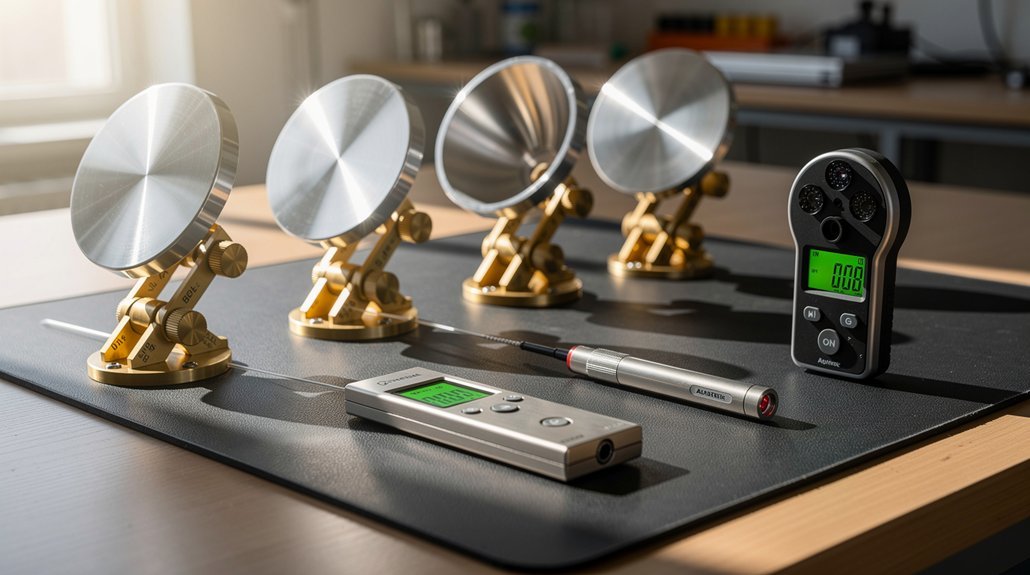
For ideal solar cooking, you'll want to start between 9-10 AM, positioning your cooker east-facing to catch morning rays. Adjust your cooker every 30 minutes to track the sun's path, keeping shadows balanced on both sides. At midday, align directly with overhead sun for peak efficiency, then shift westward for afternoon cooking. During winter, tilt your cooker around 60 degrees, while summer allows for flatter angles. You'll achieve the best results between 11 AM and 3 PM when solar intensity peaks. Proper sun alignment techniques and seasonal adjustments can transform your outdoor cooking experience.
Morning Setup For Solar Cooking

When you're ready to harness the sun's energy for cooking, starting your setup in the morning provides the best opportunity for success. Your prime cooking window falls between 9:00 AM and 12:00 PM when the sun's position is most favorable.
Begin by preheating your solar oven 30 minutes before cooking to maximize heat gain. Position your cooker in a spot free from shadows and obstacles, adjusting its angle to track the sun's path. Remember to rotate every 30 minutes to maintain optimal sun exposure throughout the cooking process.
You'll want to paint the interior with black, high-heat paint and add insulation like crumpled newspapers or fiberglass batting. Don't forget to include thermal mass, such as a brick, to maintain consistent heat.
Check the weather forecast beforehand – sunny days are ideal for full meals, while partly cloudy conditions work better for quick-cooking foods. Pre-soak ingredients the night before if you're planning long-duration cooking.
Early Sun Position Basics
Understanding the sun's position during early hours is essential for successful solar cooking. You'll want to begin your cooking journey between 9:00 and 10:00 a.m. for lunch preparations, as the sun's intensity peaks from 10:00 a.m. to 2:00 p.m.
For best sun alignment during morning cooking sessions:
- Position your cooker's front side facing east
- Confirm the shadow falls directly behind the unit
- Place the cooker on a level, dry surface
- Avoid areas where trees or buildings cast shadows
The sun's position varies by location and season, so you'll need more frequent adjustments during shorter days.
While southern regions like Arizona offer prime conditions, you can still cook effectively in less sunny areas – just expect longer cooking times and plan accordingly. The Global Solar Oven can be flipped upside down to better capture sunlight during these challenging conditions.
Midday Angle Adjustments

To maximize your solar cooking during peak sun hours, you'll need to position your cooker directly facing the sun at midday and adjust it every 30 minutes to maintain ideal temperatures.
You can track the alignment by observing shadows on both sides of your cooker, ensuring they're even for the most effective heat absorption.
For the best results, raise or tilt your cooker's elevation to match the sun's position in the sky, especially as it moves from east to west during cooking time. The success of solar cooking depends heavily on direct sunlight exposure, making it essential to avoid any shadows falling across the cooking area.
Peak Sun Position Tips
Maximizing your solar oven's efficiency depends heavily on proper positioning during peak sunlight hours.
You'll achieve ideal cooking temperatures between 1 PM and 2 PM when you align your oven directly into the sun. Remember to preheat for 20 minutes on clear days before adding food.
For best results during peak sun hours:
- Position your oven facing due south to capture maximum sunlight throughout the day
- Check alignment every 30 minutes and adjust to maintain ideal temperature
- Keep reflectors clean and properly angled to distribute heat evenly
- Use a leveled rack instead of placing pots directly on the oven floor
When cooking unattended, aim your oven toward where the sun will be during its strongest period.
Don't forget to use oven mitts, as temperatures can reach 250°-400°.
Shadow Tracking Methods
While tracking shadows might seem complex, this precision method helps you fine-tune your cooking angles during midday sun shifts.
You'll need a depth camera mounted above your counter to monitor object placement and movement. The system tracks height thresholds and alerts you if ingredients aren't positioned correctly.
Your digital scale connects via Bluetooth to measure quantities in real-time, automatically adjusting recipe steps based on your progress.
You'll see projected instructions directly on your work surface, complete with arrows and numbers guiding each step. If the automatic tracking isn't sufficient, simply place your hand over the outlined area to advance.
The integrated setup guarantees you're working at ideal angles, with the projector and camera system providing continuous feedback to prevent errors during critical midday cooking periods.
Optimal Elevation Adjustments
Building on the precision tracking system, proper elevation adjustments can make or break your midday cooking success.
You'll need to carefully tilt your box cooker to compensate for the sun's angle, especially if you're cooking in higher latitudes or during winter months. For ideal performance, raise your cooker's leg to maintain a direct line between the sun and ground.
- Adjust your box cooker's tilt more frequently if you're in northern regions
- Position reflectors to redirect sunlight to the opposite side of your target area
- Set top reflectors at steeper angles and bottom reflectors more shallowly when the sun's low
- Use adjustable legs to prevent spills while maintaining proper tilt angles
Afternoon Solar Cooking Positions
To achieve ideal cooking results in the afternoon, you'll need to position your solar cooker with precise attention to the sun's westward movement.
Start cooking between 1:00 and 2:00 pm by orienting the shorter front panel toward the west, where the sun will be mid-afternoon.
Watch the shadow under the front flap – it shouldn't exceed half the flap's width. You'll need to adjust your cooker every 30 minutes to maintain best temperatures between 200°F and 300°F.
Check that shadows appear even on both sides of the oven for proper alignment. In late afternoon, raise the cooker's leg to tilt it toward the sun, creating a straight line from the sun to the ground.
For longer cooking sessions, reposition your cooker every couple of hours and use dark-colored cookware to maximize heat absorption.
Geographic Location Impact

Location plays an essential role in determining your solar cooking success. If you're near the equator, you'll benefit from more direct sunlight, while living further north or south means dealing with angled rays that reduce cooking efficiency.
- Choose cooking spots based on your latitude – the closer to the equator, the better your results
- Consider your elevation, as higher altitudes can provide stronger, unfiltered sunlight
- Factor in local weather patterns – desert regions offer ideal conditions, while coastal areas may present challenges
- Adapt to your specific environment, whether you're in a mountainous region with varying exposure or an urban area with potential obstructions
Your geographic location impacts more than just cooking angles – it influences the best times for solar cooking and the types of recipes you'll successfully prepare throughout the year.
Seasonal Changes Matter
Seasonal changes dramatically affect your solar cooking approach throughout the year, as the sun's position and intensity shift with Earth's tilted rotation.
During winter solstice, you'll need to adapt to less than half the solar radiation available in summer, requiring longer cooking times and adjusted recipes.
You'll want to match your cooking style to the season's energy. Summer's intense sunlight supports quick-cooking methods and lighter meals, while winter's reduced daylight hours are better suited for slow-cooking dishes.
Align your cooking schedule with seasonal daylight patterns – start earlier in winter when sunlight is precious, and take advantage of extended summer days for multiple cooking sessions.
Consider using your solar cooker for slow-braising in winter and quick grilling in summer to work with nature's rhythm.
Elevation And Angle Relationships

Understanding elevation's effects on cooking builds directly upon the seasonal adaptations we discussed. As you climb higher, you'll need to adjust your cooking angles and techniques to account for changes in atmospheric pressure and moisture levels.
- Water boils at lower temperatures as elevation increases, requiring longer cooking times – at 5,000 feet, you're looking at 203°F instead of 212°F.
- You'll notice moisture evaporates more quickly at higher elevations, so you'll want to cover your foods and adjust liquid content accordingly.
- Atmospheric pressure drops considerably with elevation gain, affecting food structure and cooking dynamics.
- Baking temperatures need careful calibration, and you should rely on an oven thermometer for accuracy.
Remember to test and adapt your recipes since high-altitude directions aren't always reliable. The combination of elevation and cooking angles requires thoughtful adjustments to achieve ideal results.
Shadow Alignment Tips
Track your shadow movements throughout the day to understand how natural and artificial light sources affect your cooking setup at different times.
You'll want to position your workstation so that shadows form clean lines that complement your food presentation rather than distract from it.
A quick shadow check before filming or photographing will help you spot and correct any unflattering angles or dark spots that could diminish your final result.
Track Shadow Movement Daily
Why do professional food photographers obsess over shadow patterns? They know that tracking daily shadow movements is essential for capturing the perfect shot. Natural light constantly changes, affecting how your food appears throughout the day.
To master shadow patterns, you'll need to understand:
- Morning and afternoon sun creates longer, defined shadows perfect for dramatic food shots
- Midday lighting produces shorter shadows, often less ideal for photography
- Point light sources like direct sunlight create sharp, defined edges
- Diffused light, like on cloudy days, softens shadows naturally
You can predict the best shooting times by consistently monitoring shadow behavior.
If you're working indoors, control harsh shadows using a 3-point lighting setup, positioning your key light 45° from the camera. For darker backgrounds, block light from multiple directions, leaving just one primary light source.
Perfect Position Through Lines
How you position your light source directly impacts the shadow lines in your food photography. To achieve balanced shadows, you'll need to master the relationship between light placement and form shadows.
For softer shifts, position your light source at a 45-degree angle to create gentle shadow lines that enhance depth without overpowering your subject. You'll want to keep highlights on the light side and darker tones in the shadow areas, maintaining a smooth bed-bug line between them.
When dealing with multiple food items, place taller elements further from your light source to prevent them from casting shadows on shorter items.
Use reflectors strategically to bounce light back into shadow areas, especially when you're working with natural light. This technique helps maintain detail in your shadow sides while preserving the three-dimensional quality of your food.
Quick Check Shadow Guide
Building on our lighting principles, let's focus on a practical checklist for shadow management. You'll want to position your food near a window, utilizing indirect natural light while avoiding harsh direct sunlight. For the best results, shoot during cloudy days or golden hour when the light naturally diffuses.
- Place taller items further from your light source to prevent unwanted shadows on other elements
- Use a white card or reflector to bounce light into darker areas
- Position a diffuser between your light source and the subject for softer illumination
- Rotate your dish to find the ideal angle where shadows enhance rather than detract
When you're working with artificial light, remember to filter it through a translucent screen.
If needed, adjust your camera height and angle to capture the most flattering shadow placement.
Tilt Methods For Box Cookers

Proper tilt adjustment stands as an essential factor in maximizing your box cooker's efficiency.
You'll need to align your cooker with the sun's rays throughout the day, particularly during winter months when the sun sits lower in the sky.
To achieve ideal positioning, check the shadows on your cooker's sides for east-west alignment and the oven box for up-down adjustments.
Set your reflector panels at approximately 60 degrees from the box's opening, though you can adjust between 30-60 degrees based on sun conditions.
When dealing with low sun positions, use multiple reflector angles – steeper for top panels and shallower for bottom ones.
If you're using a box cooker like the Global Sun Oven or SOS Sport, you'll benefit from their built-in compensated inclines that help prevent pot tipping while maintaining effective cooking angles.
Parabolic Cooker Positioning
While solar cooking can be forgiving with many designs, parabolic cookers demand precise alignment with the sun to achieve their exceptional cooking temperatures.
You'll need to track the sun's movement throughout the day, as even slight misalignment can greatly reduce your cooker's effectiveness.
Consider these key positioning elements for ideal performance:
- Set your focal height to one-fourth of the aperture length for maximum angle tolerance
- Install a tracking mechanism, such as a crank arm or swiveling base, to easily adjust alignment
- Use compound parabolic designs if you want up to 3 hours of cooking without constant adjustments
- Choose larger target sizes for more forgiving alignment, though this reduces concentration ratio
For best results, combine these approaches with sturdy materials and a reliable tracking system that matches your local needs and available resources.
Winter Sun Tracking

Tracking the sun becomes more challenging during winter months when its path follows a lower, shorter arc across the southern sky. You'll need to adjust your solar cooker's angle to around 60 degrees to compensate for this seasonal shift.
To maximize your winter cooking success, use tools like the Sun Path Chart Program to predict the sun's daily movement. Position your cooker in a south-facing location with minimal obstructions, and plan your cooking during midday hours when the sun reaches its highest point.
You can stabilize your cooker using bricks or wooden blocks to maintain the ideal angle toward the southern horizon.
While winter brings lower sun intensity, some regions actually experience clearer skies during this season, making solar cooking surprisingly effective with proper positioning and timing.
Summer Solar Angles
Unlike winter's low sun path, summer offers perfect solar cooking conditions with the sun reaching higher angles in the sky.
You'll find that cooking between 11:00 am and 3:00 pm maximizes efficiency when the sun is most direct overhead. Position your cooker to face the sun directly, and you'll need fewer adjustments throughout the day.
- Box and parabolic cookers perform exceptionally well in summer, reaching temperatures up to 400°F
- Place your cooker in a sheltered spot to prevent wind from affecting stability
- Use black pots and high-temperature baking bags to enhance heat retention
- Tilt your cooker slightly to match the sun's angle for peak performance
For best results, make sure there's minimal shadow on your cooker and reposition it as needed to maintain direct sun alignment throughout your cooking session.
Multiple Cooker Setup Strategies

Setting up multiple cookers simultaneously requires careful planning and organization to maximize efficiency. You'll need to strategically position each unit, guaranteeing proper lid sealing and valve settings for different cooking methods.
| Setting Type | Pressure Cooking | Non-Pressure Cooking |
|---|---|---|
| Lid Position | Clockwise Seal | Glass Lid/Unsealed |
| Valve Setting | "Sealing" | "Venting" |
| Fill Level | ½ for rice/beans | ⅔ maximum |
When using multiple units, you'll want to customize your programs based on each recipe's requirements. Start with adding the correct liquid ratios – 1:1 for long-grain rice or 1:1.25 for short-grain. Don't forget to attach necessary accessories like steamer trays or trivets before sealing. Remember to adjust cooking times and pressure levels according to your specific recipes, and always guarantee you've properly positioned the inner pots before starting.
Frequently Asked Questions
Can Solar Cooking Work Effectively on Partly Cloudy or Hazy Days?
Yes, you can still solar cook on partly cloudy days, but you'll need longer cooking times. Choose quick-cooking foods like rice or potatoes, and maintain a UV index of 4-5 for best results.
How Do Wind Conditions Affect the Positioning of Solar Cookers?
You'll need to secure your solar cooker firmly against wind to prevent tipping. Place it in a sheltered spot and adjust its position more frequently, as wind can disrupt ideal sun exposure and stability.
What Backup Methods Should I Have When Solar Cooking Fails?
You'll need reliable alternatives like gas stoves, charcoal grills, or portable electric cookers. Keep thermoses for heat retention and plan cold meals. Don't forget to stock emergency cooking fuel and non-perishable foods.
Do Different Colored Cooking Pots Affect the Required Angle Adjustments?
No, your pot's color doesn't affect angle adjustments. You'll need to realign your solar cooker every 1-2 hours to follow the sun's path, regardless of whether you're using black, silver, or colored pots.
How Does Atmospheric Pollution Impact Solar Cooker Angle Effectiveness?
When you're dealing with atmospheric pollution, you'll need more frequent angle adjustments to maximize limited sunlight. Heavy pollution scatters rays, making your standard angle calculations less effective and requiring closer monitoring throughout cooking.
In Summary
You'll get the best results from your solar cooking by staying attentive to the sun's movement throughout the day. Remember to check your cooker's position every 30 minutes and adjust accordingly. Don't forget that your geographic location affects ideal angles – what works in Arizona won't match Maine's needs. Whether you're using a single parabolic cooker or multiple devices, proper sun alignment means faster, more efficient cooking.