To get maximum heat from your sun oven, position it at an angle matching your geographical latitude, then adjust based on the season. You'll need to increase the angle by 15-20 degrees in winter and decrease it by 15 degrees in summer. For example, if you're at 40 degrees latitude, aim for about 55-60 degrees tilt in winter and 25 degrees in summer. Regular adjustments every 15-30 minutes keep your reflectors aligned with the sun's movement, helping you reach temperatures up to 448°F. There's much more to optimizing your solar cooking setup for peak performance.
Finding Your Perfect Solar Angle
How do you maximize your sun oven's performance? The key lies in positioning your oven at the ideal angle to capture the most sunlight.
You'll need to take into account your geographical location and the season to get it right. For year-round cooking, set your oven's angle close to your latitude.
If you're focusing on winter cooking, angle it steeper—about 15-20 degrees more than your latitude. During summer, a flatter angle (about 15 degrees less than your latitude) works better. With proper angle adjustments, you can achieve 448°F temperatures even in cold conditions.
For example, if you're in Winnipeg at 50 degrees latitude, you'd want 66 degrees for winter and 27 degrees for summer.
Remember to maintain an unobstructed southern view and adjust for the sun's daily path to achieve maximum heat generation.
Understanding Reflector Position
When setting up side-mounted reflectors for your sun oven, you'll want to position them at angles that track the sun's daily east-to-west movement.
You can maximize heat concentration by adjusting your reflectors every 15-30 minutes to maintain ideal sunlight capture throughout the day.
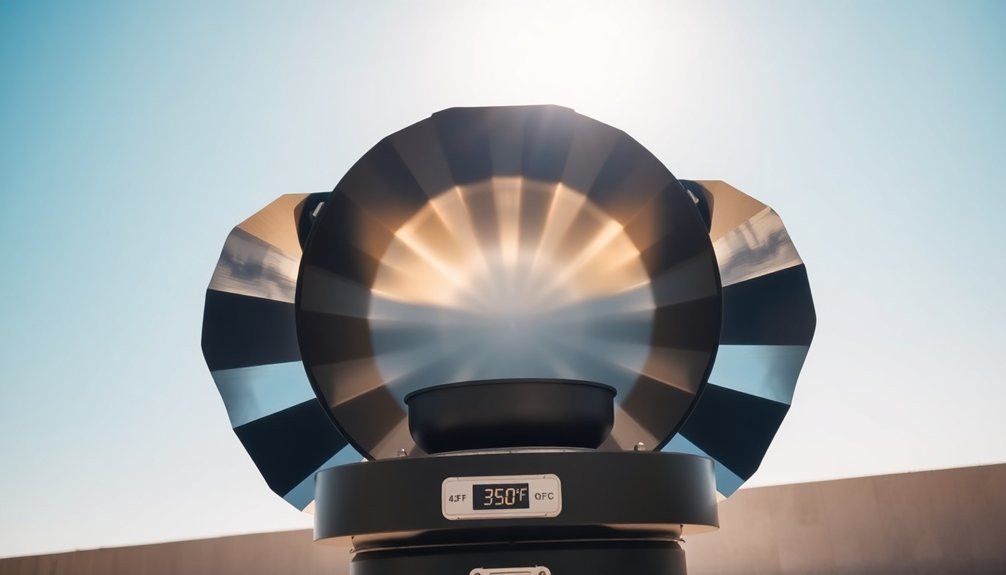
Your reflectors should be angled to direct sunlight onto the opposite side of your cooking target, creating an intense heat zone for efficient cooking. Orient the solar cooker with the shorter front panel eastward for optimal cooking around noon, or position it westward for evening meal preparation.
Side-Mounted Reflector Setup
Setting up side-mounted reflectors correctly can make or break your solar oven's performance. You'll want to position your reflectors at approximately 60 degrees from the oven's face for standard setups, though you can adjust between 30-60 degrees based on the sun's position. Use sturdy support mechanisms like hinges or thumbscrews to secure your reflectors in place. The reflector can achieve temperatures up to 204 degrees Fahrenheit when properly aligned.
| Position | Angle Range | Key Consideration |
|---|---|---|
| Morning | 30-45° | Steeper angle to catch rising sun |
| Midday | 45-60° | Maximum exposure to overhead sun |
| Afternoon | 30-45° | Adjusted for western sun position |
| Seasonal | Varies | Adapt to sun's seasonal height |
For peak heat concentration, you'll need to make continuous adjustments throughout the day. Consider using alignment indicators like E-Z Sun-track to maintain proper positioning, and verify your reflective surfaces are clean and properly secured.
Tracking Sun's Daily Path
The sun's daily journey across the sky demands careful attention to reflector positioning for superior solar cooking results.
You'll need to adjust your reflectors hourly to match the sun's path, ensuring maximum heat capture throughout the day.
Check your reflector angles every 15-30 minutes using a protractor or printed template for precision.
You can spot prime positioning by watching for shadows and using a brightly colored object in the target area as a visual guide.
Keep your reflective surfaces clean to maintain efficiency.
For best results, position your top reflector to direct sunlight toward the opposite side of your cooking target, creating a concentrated heat zone.
Center your cookware at the focal point, and remember to maintain a 15° tolerance during unattended cooking periods to compensate for the sun's movement.
Seasonal Adjustments Matter
Your sun oven's position needs significant changes between summer and winter to capture maximum heat, with winter requiring a steeper tilt angle of latitude plus 10 degrees at locations above 25 degrees latitude.
You'll find summer positioning more forgiving, often working well with a horizontal placement near the equator or a latitude-based tilt in other regions.
For quick adjustments throughout the day, check that shadows fall evenly on both sides of your oven and use the sun's straight line to the ground as your alignment guide.
Summer Vs Winter Positioning
Proper positioning of sun ovens varies dramatically between summer and winter due to significant changes in the sun's elevation.
During summer months, when the sun sits high above 40°, you'll need minimal tilting of your oven, especially at mid-day. You'll find best results by aligning the shadows evenly on both sides and matching them with the front rim.
Winter demands a different approach. With the sun's lower position, you'll need to tilt your oven more steeply, typically at your latitude plus 10°. You'll also need to adjust your reflectors more frequently to maintain focus throughout the shorter days.
Quick Adjustment Methods
Maintaining ideal sun oven performance requires mastering several quick adjustment methods that vary by season.
You'll need to align shadows evenly on both sides and adjust reflector panels to match the sun's elevation throughout the day.
Use the E-Z Sun-track indicators on your glass door by centering the light dot over the bottom hole.
You'll want to make adjustments every 30 minutes to maintain peak heat, especially during peak hours between 10 am and 2 pm.
For coordinated reflector systems, adjusting one panel will align the entire array.
Don't forget to secure your oven with wire stakes through the alignment leg base on windy days.
Position your oven to face where the sun will be strongest during your cooking session, using the alignment leg to achieve proper tilt.
Latitude Impact on Tilt
Since the sun's angle varies throughout the year, you'll need to adjust your solar oven's tilt based on your latitude. For example, at 40.66° N latitude, you'll want a 15° tilt for best performance.
If you're at higher latitudes, you'll need steeper angles to capture the sun's more oblique rays. Your geographical location greatly impacts how much you'll need to adjust your oven.
Near the equator, you won't need as much tilt adjustment since the sun's rays are more direct. However, if you're in higher latitudes, you'll need to make more dramatic seasonal adjustments, especially during winter when the sun sits lower in the sky.
Many commercial models, like the Global Sun Oven, come with adjustable tilt features to help you maximize heat based on your location.
Shape and Efficiency Connection
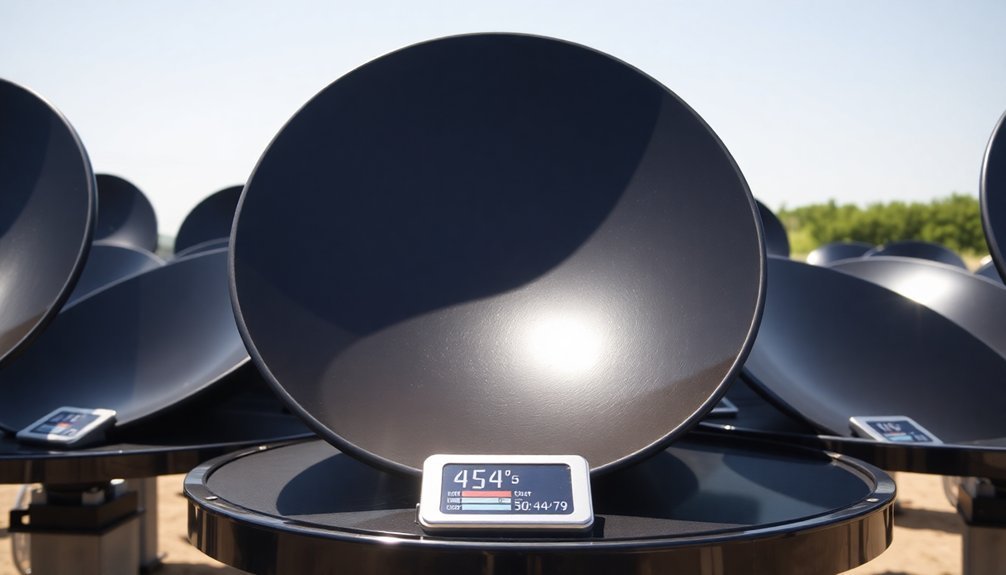
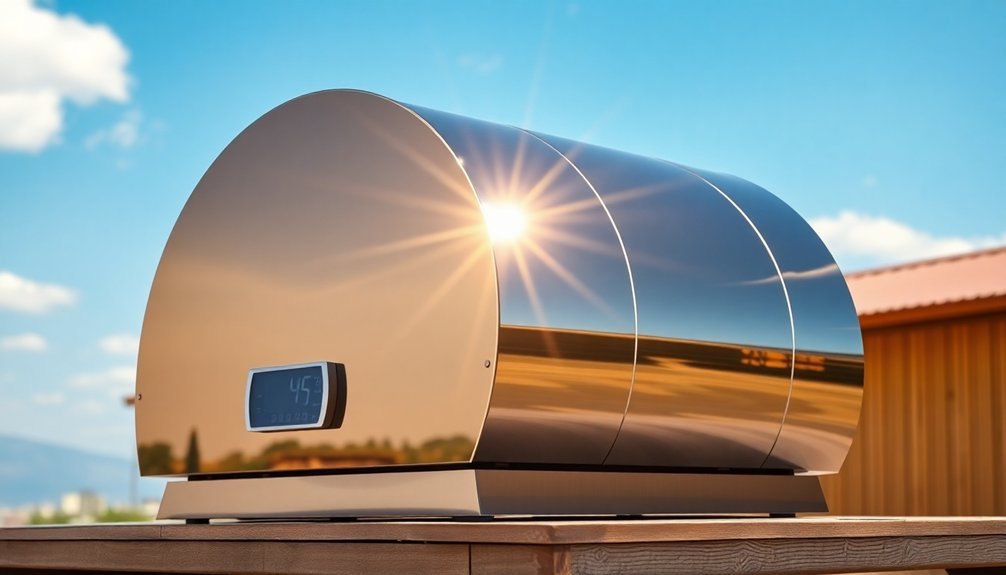
The shape of your solar oven directly influences its heat efficiency and cooking performance. Among the three main designs, tube-type ovens lead with 46% efficiency due to their vacuum shell technology, while box-type ovens offer practical manufacturing benefits. Parabolic designs, despite their complexity, achieve the lowest efficiency at 18.5%.
| Design Type | Key Features | Efficiency | Max Temp |
|---|---|---|---|
| Tube-Type | Vacuum Shell | 46.097% | 200°C+ |
| Box-Type | Insulated Box | 25-35% | 180°C |
| Parabolic | Mirror Focus | 18.492% | 150°C |
| Hybrid | Mixed Design | 30-40% | 190°C |
You'll get better results by focusing on geometric optimization through proper insulation, minimized thermal bridges, and enhanced natural convection. Your oven's efficiency also depends on reflector positioning and thermal mass optimization to maintain stable cooking temperatures.
Heat Retention Design Elements
Effective heat retention in solar ovens depends on four key design elements working together: high-quality insulation, strategic reflector placement, thermal mass storage, and efficient glazing systems.
You'll want to surround your cooking chamber with food-grade insulation materials like spun fiberglass, rockwool, or cellulose, while using aluminum foil as a radiant reflector.
For peak performance, position your reflectors at a 30° angle and adjust them throughout the day to maximize sunlight capture.
- Use black ceramic or metal top layers to convert sunlight into heat energy
- Install low-iron tempered glass doors with anti-reflective coating for better heat retention
- Add thermal mass materials like bricks or salt to store heat for extended cooking
- Guarantee R90 insulation values for floors and sides in colder climates
Frequently Asked Questions
How Long Does It Take to Recalibrate Reflectors for Optimal Heat?
You'll need 2-3 minutes to recalibrate your reflectors every hour. For seasonal adjustments, spend 5-10 minutes ensuring proper angles. It's a quick process once you're familiar with your sun oven's mechanisms.
Can Multiple Sun Ovens Be Stacked to Increase Heating Efficiency?
You shouldn't stack sun ovens as it'll reduce their efficiency. Each oven needs direct sunlight and proper airflow. Instead, place them side by side and focus on optimizing individual units for better results.
Does Wind Speed Affect the Recommended Angle Settings?
Wind speed doesn't directly affect your angle settings, but you'll want to use reflectors and glazing as shields against wind. Focus on maintaining the ideal 20-25 degree angle while protecting against heat loss.
What Backup Angle Settings Work During Partially Cloudy Conditions?
You'll want to reduce the oven's incline slightly during partly cloudy conditions to maintain stability. Adjust between 5-10 degrees less than ideal angles, and consider switching to box cookers for better performance in variable weather.
Do Different Cooking Vessel Materials Require Adjusted Oven Angles?
You don't need to adjust your oven angles for different cooking vessel materials. Just focus on using dark, thin vessels that absorb heat well. The material's color matters more than adjusting the angle of your cooker.
In Summary
You'll get maximum heat from your solar oven when you position it at an angle equal to your latitude plus 10 degrees in winter, or minus 10 degrees in summer. Remember to adjust your reflectors regularly throughout the day to track the sun's movement. For ideal year-round performance, keep your reflective surfaces clean and consider using adjustable legs to maintain the perfect angle.