
Your sun oven should face directly towards the sun, with a southerly orientation if you're in the Northern Hemisphere or northerly if you're in the Southern Hemisphere. For peak performance, position your oven in a spot that receives unobstructed sunlight, especially between 10 AM and 2 PM. You'll need to adjust the oven's position every 30 minutes to track the sun's movement across the sky. Use the E-Z Sun-track indicators to guarantee precise alignment, and check that shadows fall evenly on both sides of the cooking chamber. Understanding additional positioning techniques can maximize your solar cooking success.
Understanding Solar Cooking Fundamentals
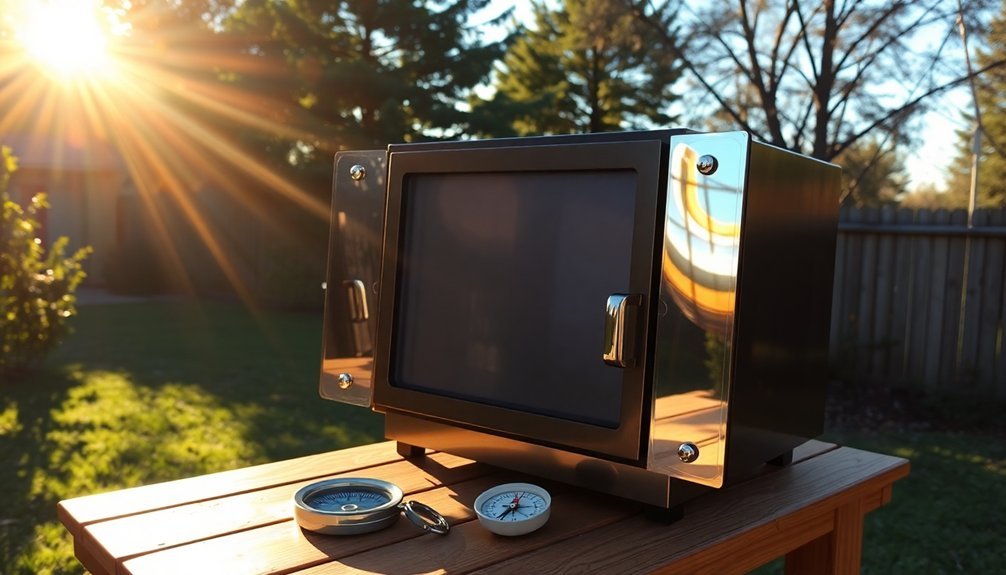
Before you can properly position your sun oven, understanding how solar cooking works is essential. Your solar oven converts sunlight into heat energy through a simple but effective process.
When sunlight hits the reflective surfaces of your oven, it's concentrated and directed through a glass lid into an insulated cooking chamber. Never look directly at the reflected sunlight while positioning your oven, as it can damage your eyes.
The cooking container, typically painted matte black, absorbs this concentrated light and transforms it into heat energy. Your oven's insulated walls, which might contain materials like newspaper or fiberglass batting, help trap this heat inside the cooking chamber.
You'll find a thermal mass, such as a brick or large rock, can improve heat retention. The transparent lid serves two purposes: it allows sunlight to enter while preventing heat from escaping, creating a greenhouse effect inside your oven.
Optimal Sun Oven Placement
To get the most from your sun oven, you'll need to scout a location that receives full, unobstructed sunlight throughout your cooking time.
You'll want to monitor the sun's path across your chosen spot, noting any shadows from trees or structures that might interfere during different times of day.
The ideal placement of your sun oven will shift with the seasons, requiring you to adjust its position as the sun's angle changes between summer and winter months. For optimal cooking performance, position your oven to face directly south when using it like a slow cooker.
Finding Prime Solar Spots
Successfully placing your sun oven depends heavily on finding the perfect sunny location in your yard or outdoor space.
You'll want to scout a spot that receives uninterrupted sunlight, particularly during peak hours between 10 AM and 2 PM.
Look for an area that's free from trees, buildings, or other structures that might cast shadows as the sun moves across the sky. Your chosen location should stay sunny for at least 30-45 minutes each hour.
If you're in the Northern Hemisphere, position your oven facing south to maximize sun exposure. This south-facing direction can improve your sun oven's energy absorption by up to 30% or more.
Remember to take into account potential wind exposure – it's best to find a relatively sheltered spot to prevent your oven from becoming unstable.
When you've found your location, make sure you can easily access it for adjusting the oven's position throughout cooking time.
Tracking Sun Path Movement
Tracking your sun oven's position throughout the day plays an essential role in achieving ideal cooking temperatures. To maintain prime alignment, face the oven directly into the sun and use the E-Z Sun-track indicators – when sunlight passes through the top hole, it should create a centered dot over the bottom hole.
Adjust your oven every 30 minutes using the T-shaped alignment leg and rear bracket to follow the sun's path. If you'll be away, position it where the sun will be strongest (between 1-2 PM). The Sun Oven can reach temperatures of 400°F on clear, sunny days with proper alignment.
For early morning cooking, point it due south to catch the first rays. Keep the glass door tightly latched and unfold the reflectors properly to maximize heat retention.
In windy conditions, secure the oven with wire stakes through the alignment leg base.
Seasonal Placement Adjustments
While ideal sun oven performance depends heavily on seasonal changes, you'll need to make specific adjustments throughout the year to maximize your cooking efficiency.
During summer months in southern latitudes, you can enjoy up to 13 hours of cooking time using the standard setup with properly aligned reflectors. No special angle adjustments are needed.
Winter cooking requires more attention to positioning. You'll have about 5 hours of cooking time, and you'll need to extend the T-leg fully to accommodate the sun's lower angle.
If you're in higher latitudes, lay your oven on its back for better sun exposure. Keep the reflectors open and secured with the thumbscrew, using the carrying handle for stability. This setup works effectively even in below-zero temperatures.
Using Alignment Indicators Effectively
Making the most of your Sun Oven's alignment indicators guarantees ideal cooking performance and temperature maintenance.
You'll find white E-Z Sun-track indicators on the bottom corners of the glass door. Stand behind or to the left of the oven and adjust it until the sun's round light dot centers through both holes.
You can also use the shadow method by ensuring even shadows on both sides while eliminating shadows in the cooking chamber. The adjustable leg helps you achieve proper vertical angling for optimal alignment.
Remember to reposition your oven every 30 minutes to track the sun's movement. If you can't make frequent adjustments, aim the oven toward where the sun will be during peak hours (10 AM-2 PM).
For stability in windy conditions, secure the alignment leg with stakes, which keeps your oven steady in winds up to 35 MPH.
Seasonal Sun Path Variations
Your sun oven's ideal facing direction changes considerably between summer and winter, as the sun's path shifts from a higher to lower arc across the sky.
You'll need to adjust your oven more steeply upward during summer months to catch the high-angle rays, while winter requires a shallower angle to capture the lower sun path.
During equinoxes, when the sun travels along the celestial equator, you can track its perfectly east-to-west movement by making small adjustments throughout the day.
Summer Vs Winter Angles
As the seasons change throughout the year, the sun's path across the sky varies considerably, requiring different positioning angles for your Sun Oven.
During summer, you'll need to aim the front directly toward the sun using the E-Z Sun-track indicators, adjusting every 30 minutes for maximum performance. The best cooking time is typically between 1 PM and 2 PM.
Winter setup requires different considerations. You'll need to extend the inclining leg fully to compensate for the sun's lower angle.
Since the sun rises in the southeast and sets in the southwest during winter, you'll need to adjust your oven's orientation accordingly. For increased efficiency in higher latitudes, you can lay the oven on its back with reflectors open.
Remember to stabilize your setup using bricks or wood blocks when adjusting for winter angles.
Equinox Tracking Adjustments
During the spring and fall equinoxes, tracking adjustments for your Sun Oven become more predictable since the sun rises due east and sets due west.
You'll need to position your oven eastward in the morning and gradually rotate it westward throughout the day to maintain ideal exposure.
If you're using a solar tracker, it'll automatically adjust your oven's orientation using photocell sensors that detect the sun's position.
The tracker's motorized platform and metal arm will keep your oven perfectly aligned without manual intervention.
You'll want to ascertain the tracker creates a slight shadow on the photocell for proper functioning.
Unlike the extreme angles needed during solstices, you can maintain moderate angles during equinoxes since the sun's path follows a more centralized route across the sky.
Weather Impact on Positioning
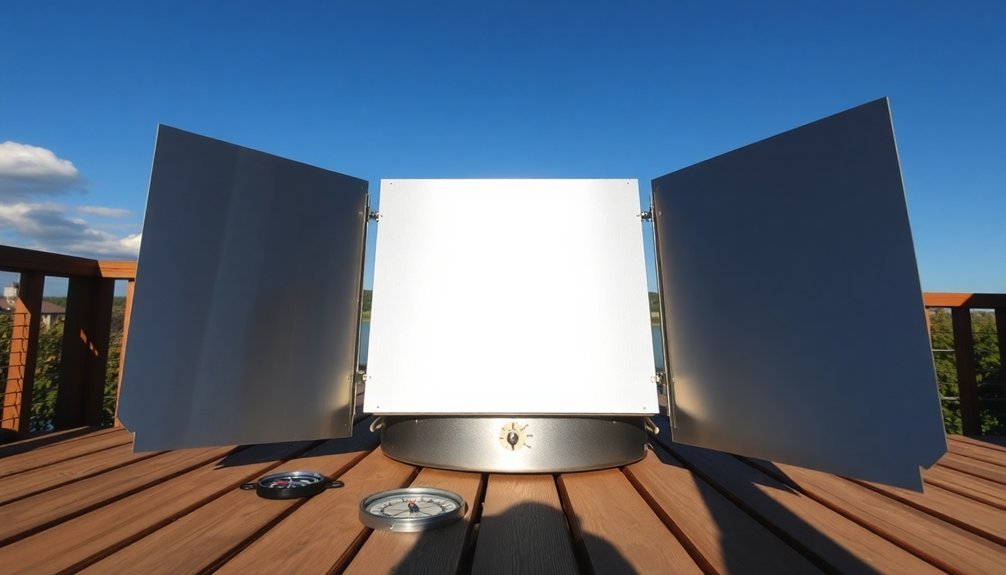
Weather conditions play an essential role in positioning your sun oven effectively. On cloudy days, you'll need to carefully consider whether using your sun oven is worthwhile, as cloud cover considerably reduces its performance.
While intermittent clouds may slow cooking, they won't completely halt the process.
When it's windy, you'll need to take extra precautions. Use the included stakes to secure your oven if winds are under 35 MPH, and don't attempt to use it in stronger winds.
The T-leg and reflectors help maintain stability, but make sure to tighten all thumbscrews. You'll also want to position your oven facing the sun when it's highest in the sky if you plan to leave it unattended.
Keep in mind that air temperature and latitude affect performance, so adjust accordingly for best results.
Maximizing Solar Energy Collection
To maximize your sun oven's performance, proper positioning and adjustment are essential for collecting solar energy efficiently. You'll need to face your oven directly towards the sun and use the E-Z Sun-track indicators to guarantee perfect alignment.
Remember to adjust the orientation every 30 minutes and tilt the oven appropriately during winter months to compensate for the sun's lower angle.
- Keep reflectors clean and properly adjusted to direct 40% more heat into the chamber
- Use aluminum foil and plastic wrap to enhance insulation and heat retention
- Check that the glass and sealing gasket are maintaining proper heat containment
- Position black paper inside to convert light energy into heat more effectively
- Adjust the alignment leg throughout the day to maintain ideal sun exposure
Wind Safety Considerations
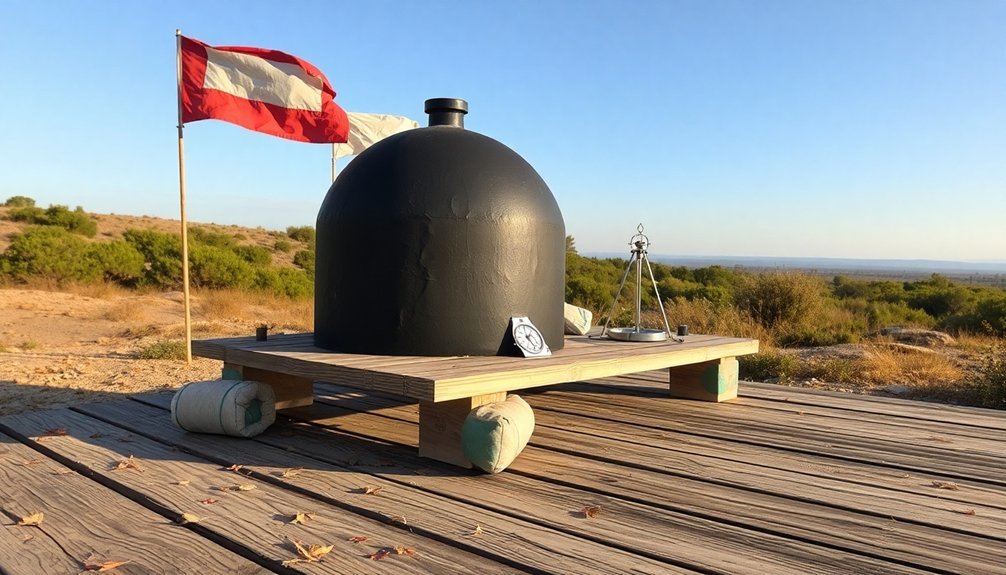
Since strong winds can destabilize or damage your sun oven, implementing proper safety measures is essential for successful solar cooking.
You'll need to secure your oven using bricks, cinder blocks, or logs against each side and the back leg. For additional stability, attach bungee cords to anchors or use guy lines made from rope or wire.
Protect your reflectors from wind damage by ensuring they're properly supported and the glass door is firmly latched.
Create a windbreak using recycled sliding glass door panels or position your oven against natural barriers like walls.
Remember that wind notably impacts cooking temperatures – a 25mph wind can drop temperatures by 400 degrees.
You'll need to adjust cooking times accordingly and use insulation to minimize heat loss during windy conditions.
Time of Day Adjustments
Beyond protecting your sun oven from wind, maintaining proper alignment throughout the day directly impacts cooking success.
You'll need to adjust your oven's position every 30 minutes to follow the sun's path and maintain ideal cooking temperature.
- Position your oven facing where the sun will be strongest (typically between 10 AM and 2 PM)
- Use the white E-Z Sun-track indicators on the glass door – center the light dot over the bottom hole
- Check for even shadows on both sides of the cooking chamber
- Adjust the rear alignment leg to eliminate front and back shadows
- Realign every 30 minutes to maintain maximum temperature
If you can't make frequent adjustments, aim your oven toward where the sun will be during its peak hours.
This strategy guarantees you'll capture the most intense sunlight for efficient cooking.
Geographic Location Effects
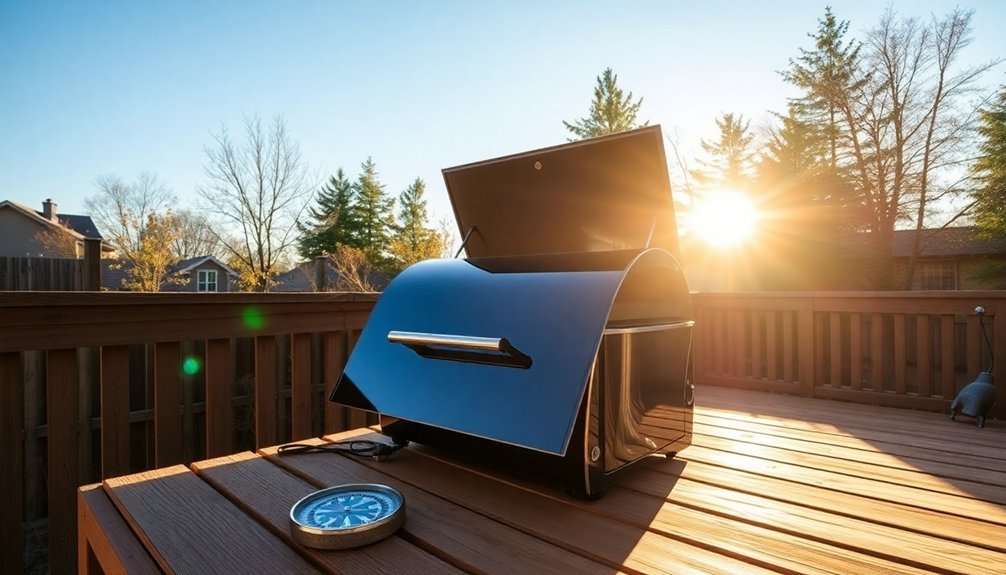
Your geographic location plays an essential role in determining how effectively your sun oven will perform. If you're near the equator, you'll benefit from more direct sunlight throughout the year, making solar cooking more practical.
At higher latitudes, you'll need to compensate for the less intense sunlight due to the sun's angular rays. Your altitude matters too – if you're cooking at higher elevations, you'll actually get better results due to less atmospheric interference and more intense UV rays.
The local climate will impact your success rate; you'll achieve the best results on clear, sunny days rather than cloudy ones. Consider your region's weather patterns when planning solar cooking sessions, as wind, dust, and rain can reduce your oven's efficiency.
You'll need to adjust your oven's position based on both your location and seasonal changes.
Maintaining Peak Cooking Temperature
To maintain peak cooking temperatures in your sun oven, proper alignment with the sun becomes essential throughout the day.
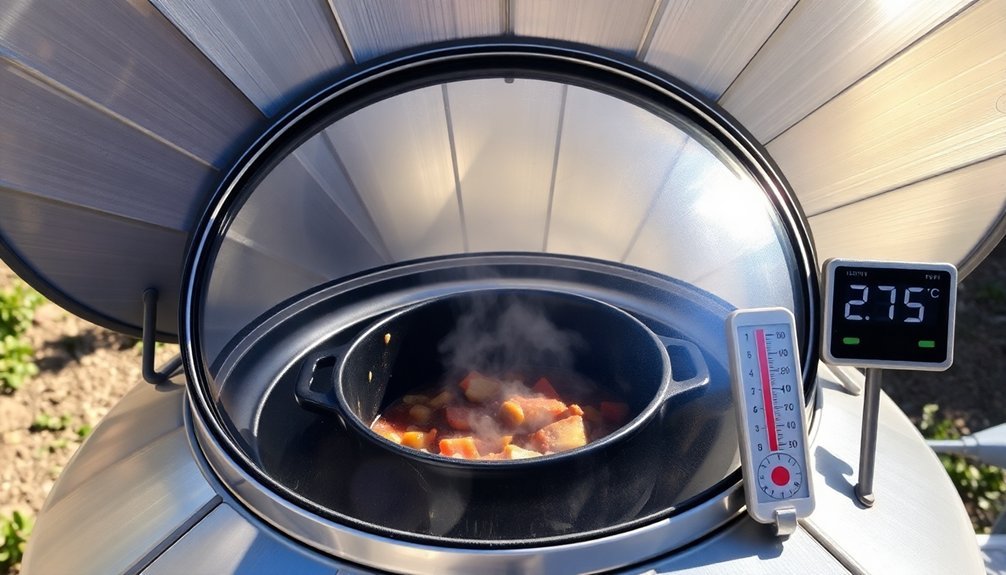
You'll need to refocus your oven every 30 minutes to achieve consistent temperatures between 300° and 375°. Use the E-Z Sun-track indicators on the glass door to verify alignment – the sunlight should create a centered dot through the top hole onto the bottom hole.
- Check shadows on both sides of the oven to guarantee even alignment
- Adjust the rear alignment leg to maintain proper tilt, especially during non-summer months
- Preheat for 20-30 minutes with the door closed and latched
- Realign the oven to follow the sun's movement throughout cooking
- Position the oven facing where the sun will be strongest (1-2 PM) if leaving unattended
Frequently Asked Questions
Can I Use My Sun Oven on a Balcony or Rooftop?
You can use your sun oven on a balcony or rooftop if there's direct sunlight. Just guarantee you have a stable surface, clear exposure to the sun, and check local regulations before setting up.
How Do Reflectors Affect Cooking Time in Partially Shaded Areas?
You'll need to adjust your reflectors more frequently in partially shaded areas. While they'll still help maintain temperatures, your cooking times will increase. Proper reflector angles can compensate somewhat for reduced sunlight exposure.
Does Painting the Cooking Chamber Black Improve Performance?
Yes, painting your cooking chamber black will considerably improve performance. You'll get better heat absorption and faster cooking times since black surfaces absorb and retain solar energy more efficiently than lighter colors.
Should Cooking Times Be Adjusted When Using Different Colored Pots?
Yes, you'll need to adjust cooking times. Dark-colored pots absorb heat better and cook faster, while light-colored pots reflect more heat and require longer cooking times. Metal pots also heat up quicker than ceramic.
Can Multiple Sun Ovens Be Positioned Side-By-Side Without Affecting Performance?
You can position multiple Sun Ovens side-by-side, but guarantee they're spaced far enough apart to avoid casting shadows on each other. Each oven needs independent sun alignment and room for periodic adjustments.
In Summary
You'll get the best results by positioning your sun oven facing true south in the Northern Hemisphere (or true north in the Southern Hemisphere) and adjusting it throughout the day to track the sun. Keep your reflectors angled at 90 degrees to maximize sunlight capture, and remember to check your oven's alignment indicators every 30 minutes. For ideal cooking, maintain this positioning between 10 AM and 2 PM when the sun's rays are strongest.

Leave a Reply