
Your sun oven loses significant power during winter for three main reasons. First, the sun sits much lower in the sky, reducing the direct sunlight your oven can capture even with adjusted reflectors. Second, you'll have fewer daylight hours available for cooking, often just 4-5 hours compared to summer's 10 hours. Third, cold ambient temperatures make it harder for your oven to maintain heat, with rapid loss through glass surfaces and any gaps in insulation. Understanding these challenges can help you optimize your solar cooking strategy and achieve better results during the winter months.
Solar Angle and Winter Sunlight
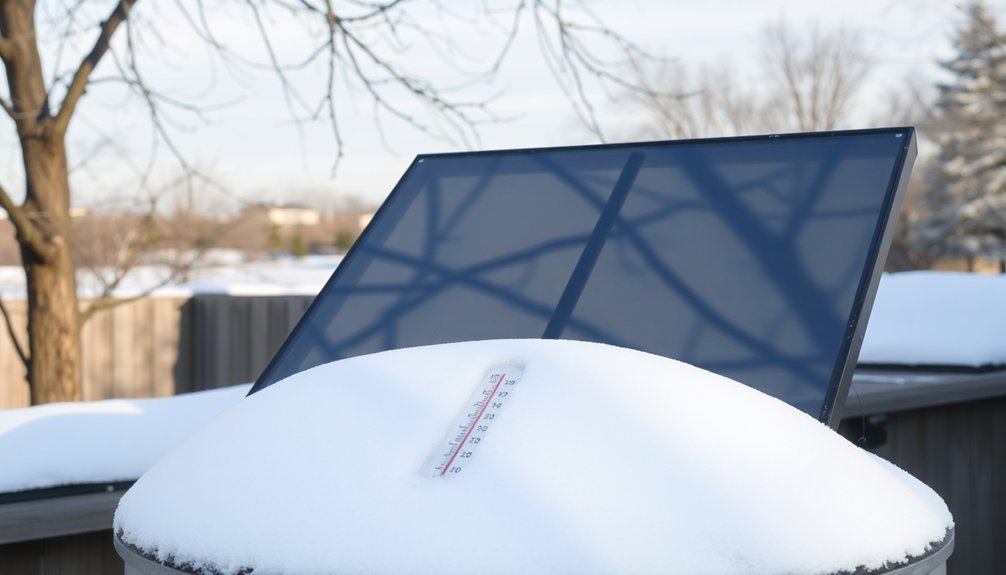
When winter arrives, the sun's lower elevation in the sky dramatically reduces the effectiveness of solar ovens.
You'll notice this impact more if you live in higher latitudes, where the sun sits particularly low during winter months. To compensate, you'll need to adjust your solar oven's angle more steeply to capture those low-lying rays.
For optimal winter performance, consider adjusting your solar oven's tilt to latitude plus 15 degrees.
Your solar oven requires the sun to be at least 45 degrees above the horizon to function effectively, which becomes challenging during winter's shorter days.
While you can still use your sun oven, you'll need to track the sun's movement more frequently and adjust accordingly.
The good news is that winter's thinner air and possible snow reflection can sometimes intensify sunlight, partially making up for the lower angle.
Using steam as a cooking indicator can help you monitor your oven's performance despite these seasonal challenges.
Reduced Daylight Hours Impact
During winter's shorter days, your solar oven's cooking window shrinks dramatically from summer's generous 10-hour span to just 4-5 hours of usable sunlight.
You'll need to carefully schedule your meals around peak sun hours, typically between 10:00 AM and 2:00 PM, when solar intensity is strongest.
Managing your solar oven becomes more demanding in winter, as you'll need to:
- Realign the oven every 25-30 minutes to track the sun's faster movement
- Plan meals exclusively during midday hours, as morning and evening cooking isn't possible
- Allow for longer preheating times and extended cooking duration
Despite these limitations, you can still achieve high cooking temperatures on clear winter days. The Sun Oven's ability to reach up to 400°F with proper alignment means effective cooking is still possible even in colder months.
The key is adapting to the shortened daylight hours and maintaining proper sun alignment throughout your cooking session.
Temperature Effects on Heat Retention
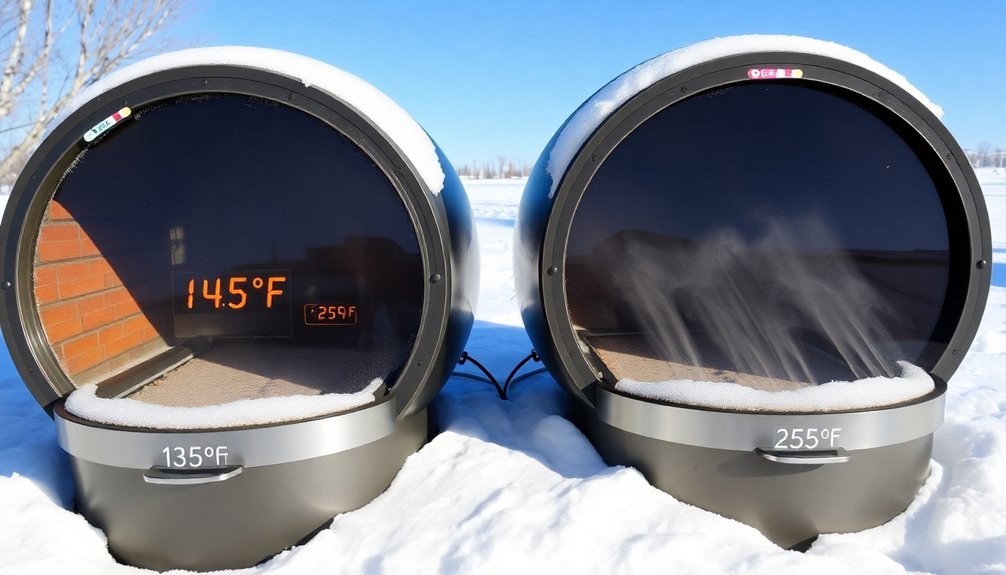
Beyond limited daylight hours, cold winter temperatures pose significant challenges for solar oven performance. Your oven must work harder to maintain cooking temperatures when fighting against the cold ambient air.
Effective insulation slows heat transfer, but winter conditions still create extra challenges for maintaining temperature. Even with good insulation, heat loss occurs more rapidly in winter, especially through the transparent window on top.
You'll notice that maintaining consistent temperatures becomes more difficult as the cold air draws heat away through conduction. While multiple glass panes and high R-value materials can help combat this issue, you'll still need to adjust your cooking times.
To maximize heat retention in winter, you should use dark cookware, cover your pots, and guarantee your oven's design minimizes surface area. Adding extra reflective panels can help offset heat loss by concentrating more sunlight into the oven.
Cold Weather Heat Loss
The multiple mechanisms of heat loss in cold weather considerably impact your solar oven's performance.
When cold air moves across your oven's surface, it creates both convective and conductive heat loss, considerably reducing internal temperatures. Even nearby reflective snow surfaces can reflect escaping radiant heat away from your oven. Wet conditions make this problem even worse, as moisture accelerates cooling through evaporation and diminishes insulation effectiveness.
Your solar oven faces these key heat loss challenges in winter:
- Wind chill accelerates cooling by constantly replacing warm air with cold air around the oven.
- Direct contact with cold surfaces draws heat away through conduction, especially if there's moisture present.
- Respiratory heat from steam escaping when you open the oven can account for up to 30% of heat loss.
Understanding these heat loss mechanisms helps you position and operate your solar oven more effectively during cold weather.
Insulation Challenges During Winter
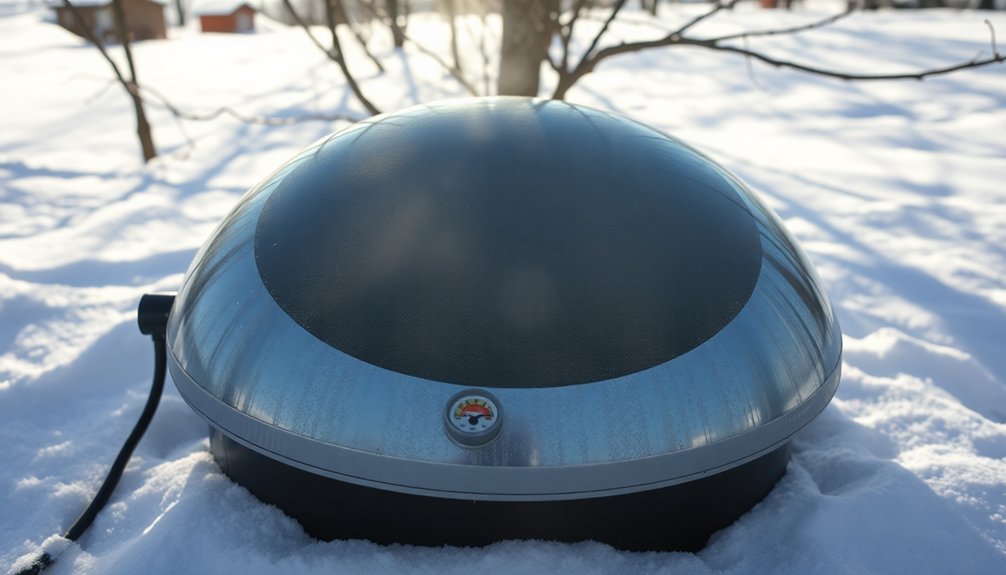
Proper insulation becomes a major challenge for solar oven users in winter months, when cold temperatures and harsh conditions test even the best insulating materials. You'll need to understand how different components work together to maintain heat during colder seasons.
| Insulation Component | Winter Challenge |
|---|---|
| Food-grade insulation | Must withstand extreme temperature variations |
| Glass doors | Need extra sealing to prevent cold air infiltration |
| Cooking chamber | Requires additional dark surface treatment |
| Sealing gaskets | Can contract and create gaps in cold weather |
| Outer shell | Faces increased thermal stress from temperature differential |
Even with high-quality fiberglass rated for 500°+ temperatures, you'll notice decreased efficiency as cold air finds tiny gaps in the insulation. That's why it's essential to check seals regularly and guarantee your oven's insulating materials haven't compressed or degraded from winter's harsh conditions.
Extended Cooking Time Requirements
You'll find that winter's reduced sunlight hours and lower sun angles markedly diminish your sun oven's heating power.
The combination of shorter days and less direct solar radiation means you're working with roughly 5 hours of viable cooking time in December, compared to 13 hours in June.
Your cooking schedules need to adapt to these seasonal limitations, often requiring multi-day approaches for dishes that normally cook in a single session during summer months.
Reduced Solar Heating Power
During winter months, solar ovens experience significant power reduction due to the sun's lower position in the sky, resulting in extended cooking times for most dishes.
You'll need to adjust your solar cooker's angle frequently to maximize sunlight exposure and maintain ideal cooking temperatures.
Different types of solar cookers require specific adjustments to compensate for winter conditions:
- Sun Ovens come with adjustable legs to help you optimize the angle for catching low winter sunlight.
- Panel-style cookers need careful positioning to effectively capture and reflect available sunlight.
- Parabolic cookers demand the most attention, requiring frequent adjustments in both elevation and trajectory as the sun moves across the sky.
To maximize your solar cooking success in winter, you'll want to focus on positioning your cooker for the most direct sunlight exposure possible.
Seasonal Temperature Loss Factors
Beyond adjusting your solar oven's position, understanding seasonal temperature loss factors helps you manage extended cooking times effectively in winter.
You'll need to double or triple your typical summer cooking times, as foods that normally take 1-2 hours may require 2-4 hours during winter months.
The combination of lower ambient temperatures and reduced sun intensity means you'll need stronger insulation to maintain cooking heat.
Using dark, thin metal pots with tight-fitting lids and cast-iron cookware can help retain precious heat.
You'll get the best results between 10:00 a.m. and 2:00 p.m., so start cooking earlier in the day.
Consider using thermal mass cookers or Dutch ovens to extend cooking beyond daylight hours.
Shield your oven from winter winds, which can quickly drain heat and greatly impact cooking efficiency.
Weather Pattern Changes
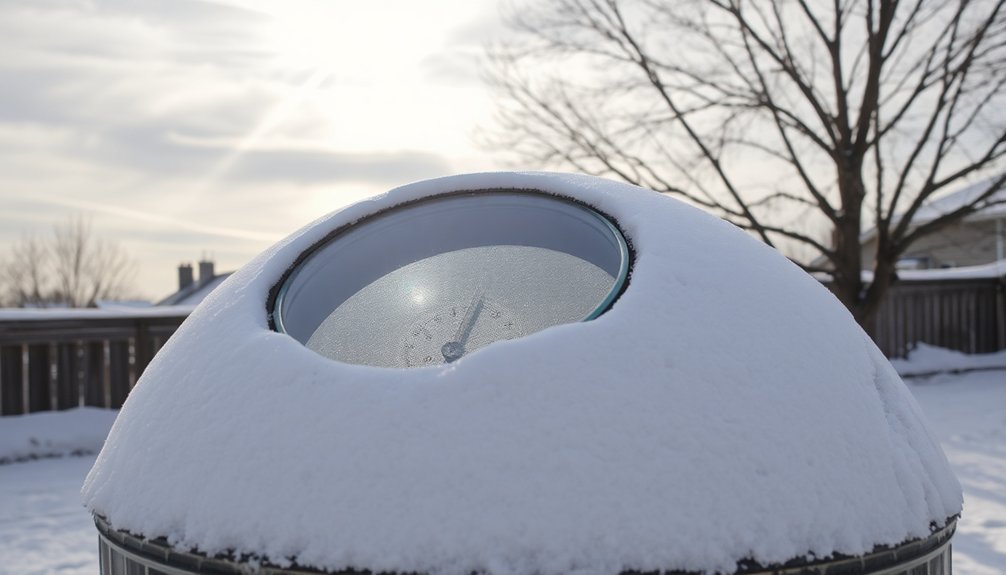
As winter settles in, solar ovens face considerable challenges due to shifting weather patterns. You'll notice more frequent cloud cover and a lower UV index, which directly impacts your cooking efficiency.
The sun's lower position in the sky means you'll need to adjust your oven's angle more steeply, making it potentially less stable.
Here's what you're up against during winter solar cooking:
- Cooking times increase considerably due to weaker solar radiation
- You'll need to start cooking earlier in the day to complete meals
- Your oven requires more frequent directional adjustments to track the sun
To maintain effectiveness, you can use additional insulation like oven roasting bags and boost performance with reflective panels.
Consider using a meat thermometer to guarantee food reaches safe temperatures despite the challenging conditions.
Geographic Location Considerations
Your solar oven's performance changes dramatically based on where you live, with locations closer to the equator receiving more direct sunlight than those at higher latitudes.
You'll notice significant seasonal variations in both hemispheres, where winter months bring lower sun angles that reduce your cooker's efficiency.
Local climate zones also play a key role in your solar cooking success, as factors like elevation and regional weather patterns directly impact the amount of solar energy reaching your device.
Latitude Affects Solar Angles
When sunlight reaches Earth at higher latitudes, it strikes the surface at a shallower angle, dramatically reducing a solar oven's power. This angled sunlight spreads the same amount of energy across a larger area, making it less intense than the direct rays you'd find near the equator.
In fact, a 30° sun angle spreads light over twice the area compared to overhead sunlight.
Your location's latitude directly impacts solar cooking effectiveness in three key ways:
- Lower latitudes receive more concentrated solar energy due to nearly perpendicular sun rays.
- Higher latitudes require more frequent cooker angle adjustments to maximize efficiency.
- Winter cooking becomes limited or impossible in northern regions due to extremely low sun angles.
To compensate, you'll need to tilt your solar oven to capture more direct rays, especially if you're cooking at higher latitudes.
Hemispheric Seasonal Variations
The dramatic tilt of Earth's axis creates distinct seasonal patterns that affect your solar oven's performance in opposite ways across hemispheres. When you're experiencing summer in the Northern Hemisphere, your counterparts in the Southern Hemisphere are dealing with winter conditions – and vice versa.
| Location | Summer Performance | Winter Performance |
|---|---|---|
| Northern Hemisphere | Peak power (June) | Reduced power (December) |
| Southern Hemisphere | Peak power (December) | Reduced power (June) |
| Equatorial Region | Consistent year-round | Minor variations |
This hemispheric flip means your sun oven's effectiveness depends heavily on your location. If you're using a solar oven in Mexico City, you'll notice considerably less power in winter, while someone in Melbourne, Australia will experience peak performance during that same period.
Local Climate Zones
Since solar ovens depend heavily on direct sunlight, your geographic location plays a crucial role in their performance. If you're in higher latitudes like northern Europe or Canada, you'll face greater challenges as the sun sits lower on the horizon, creating weaker solar irradiance and requiring deeper tilt adjustments to capture sunlight effectively.
Your local climate zone affects solar oven efficiency in three key ways:
- Clear skies and long sunny days (like in Phoenix or the Mexican Plateau) provide ideal cooking conditions.
- Cloud cover, seasonal haze, and high humidity reduce performance and extend cooking times.
- Local topography, including shade from buildings or trees, can greatly impact available solar energy.
You'll get the best results in areas with high UV indices and consistent sunlight exposure, typically found closer to the equator.
Material Performance in Cold Conditions
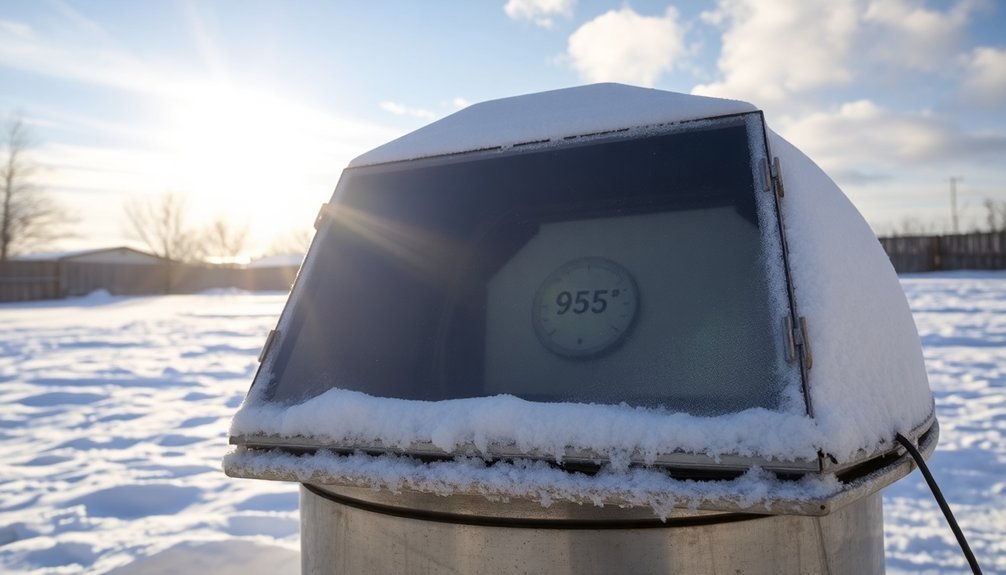
Materials used in sun ovens face unique challenges during cold weather, requiring careful consideration of their thermal properties and performance characteristics.
You'll need high-quality insulation like food-grade fiberglass to trap heat effectively and prevent thermal loss to the cold environment.
Your oven's reflective surfaces, such as aluminum foil or mirrors, become essential for maximizing limited winter sunlight. They'll direct additional solar energy to your cooking surface, helping maintain higher internal temperatures despite reduced solar intensity.
The low-iron tempered glass door will let sunlight in while trapping heat, though you'll need to watch for condensation that can reduce efficiency.
For best results in cold conditions, use dark, thin metal pots with tight-fitting lids.
These vessels, especially those made of cast iron, provide thermal mass that helps maintain cooking temperatures even when sun exposure is limited.
Design Optimization for Winter Use
When designing a sun oven for winter use, you'll need to enhance several key components to counteract the season's reduced solar intensity. The most critical adjustments focus on heat retention and maximizing limited sunlight exposure.
To improve your sun oven's winter performance:
- Increase thermal mass to about 5 kg using steel plates, which will maintain cooking temperatures for up to 30 minutes during cloud cover and reduce temperature fluctuations by 40%.
- Adjust the tilt angle based on your latitude, compensating for the sun's lower position in the winter sky.
- Add high-quality insulation like fiberglass or rock wool on all non-glazed sides to reduce heat loss by 30%.
You'll also need to reposition your oven more frequently, ideally every 30 minutes, to maintain ideal sun exposure and temperatures between 300° and 375°.
Reflector Positioning Strategies
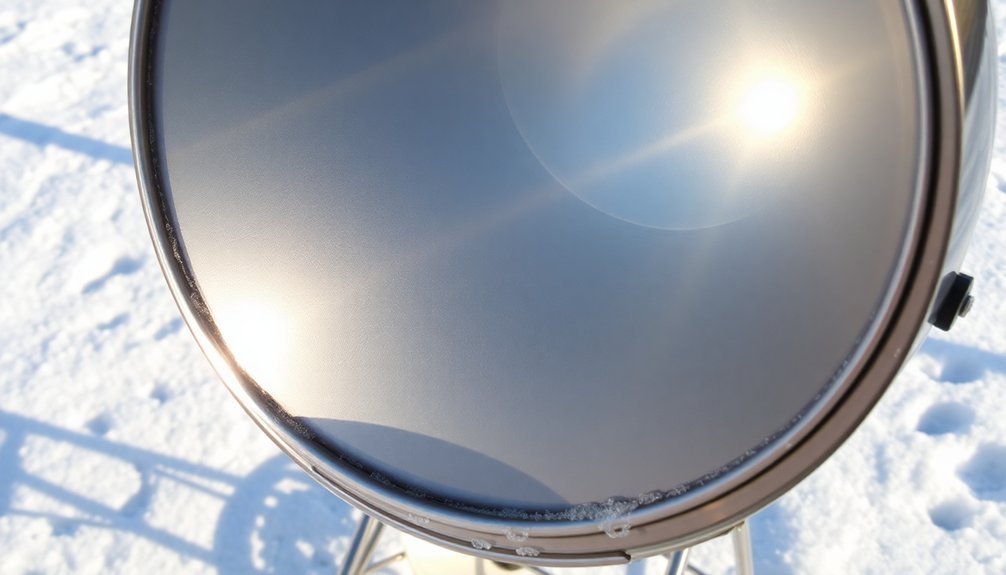
Proper reflector positioning can make the difference between a successful winter meal and a disappointing cooking experience.
You'll need to extend your reflectors to their maximum angles during winter months, often up to 60 degrees, to capture the sun's lower position in the sky.
While fixed reflectors offer simplicity, adjustable panels give you the flexibility to optimize sun exposure as seasonal angles change, making them a better choice for year-round solar cooking.
Maximize Reflector Angles
Strategic reflector positioning can make or break your sun oven's performance. To capture maximum sunlight during winter months, you'll need to increase your reflector angles considerably.
Calculate your ideal winter angle by multiplying your latitude by 0.9 and adding 29 degrees, or simply add 15 degrees to your latitude for a quick estimate.
For consistent heating throughout the day:
- Adjust your reflectors hourly to match the sun's path, maintaining a 15-degree tolerance
- Position your north-south reflectors so rays hit the base at noon
- Confirm your top reflector's rays strike the opposite side of your cooking target for concentrated heat
Check for shadows every 15-30 minutes and reposition as needed.
Remember that proper alignment of your reflective surfaces creates a focused heat zone that enhances your oven's cooking power, even during shorter winter days.
Fixed Vs Adjustable Reflectors
The choice between fixed and adjustable reflectors can dramatically impact your sun oven's performance throughout the year. Fixed reflectors offer simplicity and lower costs but can't adapt to the sun's changing position, leading to reduced efficiency, especially in winter when the sun sits lower in the sky.
You'll get better results with adjustable reflectors, which let you optimize solar energy capture as seasons change. You can set steeper angles in winter to catch the low sun and adjust them throughout the day for maximum heat concentration.
While fixed reflectors might leave you waiting longer for meals to cook during winter months, adjustable ones maintain consistent cooking temperatures through real-time positioning. If you're serious about solar cooking year-round, adjustable reflectors are worth the extra investment despite their higher cost and complexity.
Energy Absorption and Transfer
Solar ovens harness energy through a precise sequence of absorption and transfer mechanisms. When sunlight enters your solar oven, either directly or through reflection, the black interior surfaces and cooking vessels convert this light into heat energy.
Dark-colored cookware, especially black metal pans and brown glass dishes, maximizes this conversion process.
Here's how the heat stays trapped in your oven:
- A vacuum layer between glass tubes provides near-perfect insulation, preventing heat loss
- The absence of air in these tubes minimizes heat transfer to the outside environment
- The oven's reflective structure concentrates heat at the central cooking point
You'll get the best results using black-surfaced vessels with lids, as they efficiently convert sunlight into heat while the oven's insulation maintains cooking temperatures.
Environmental Factors Affecting Performance
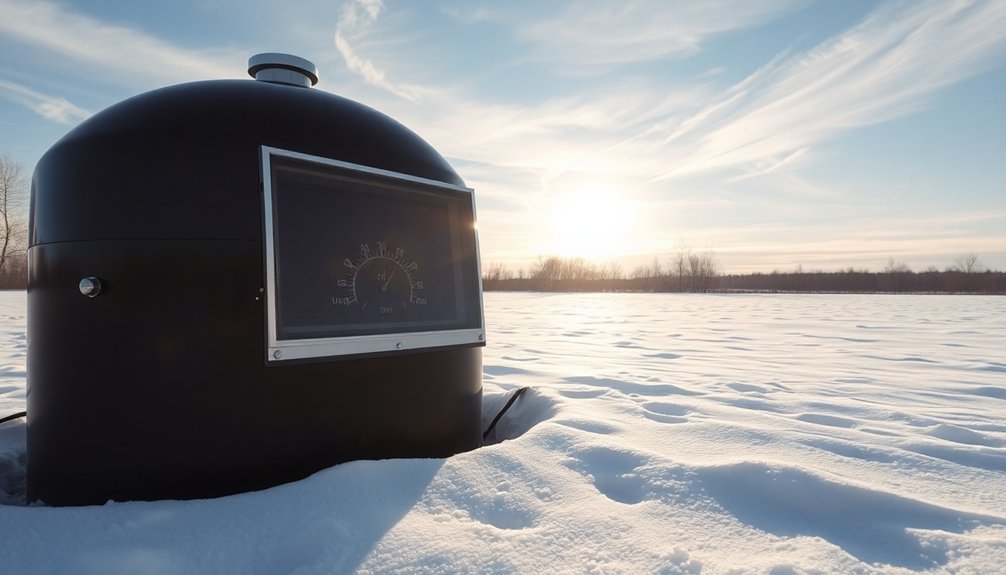
When winter arrives, multiple environmental factors combine to reduce your sun oven's effectiveness.
You'll face shorter days with less direct sunlight, as the sun sits lower in the sky and clouds frequently block its rays. Trees and buildings cast longer shadows that can interfere with your cooking location.
Cold temperatures pose another significant challenge, as they'll actively work against your oven's heat retention.
Wind accelerates heat loss, while frost and snow can cover reflective surfaces. Your oven's insulation may not perform as well in extreme cold, especially if moisture compromises its effectiveness or air leaks develop around the seals.
You'll need to reposition your oven more frequently to track the limited sunlight and might want to create windbreaks to maintain stable cooking temperatures.
Frequently Asked Questions
Can Solar Ovens Be Used to Sterilize Medical Equipment in Winter?
You can use solar ovens for medical sterilization in winter, but you'll face challenges. They'll need direct sunlight, proper insulation, and enhanced reflectors to reach sterilization temperatures of 125°C during shorter, colder days.
What Backup Heating Methods Work Best With Solar Ovens During Winter?
You'll get the best backup heating results by using parabolic cookers for quick cooking tasks, pre-heating your solar oven, and adding extra insulation like newspapers. You can also combine solar cooking with conventional ovens when needed.
Do Different Food Preservation Methods Work Differently in Winter Solar Ovens?
You'll find that drying and dehydrating work slower in winter solar ovens, while canning requires longer processing times. It's best to focus on slow-cooking methods and smaller batches for effective food preservation.
How Does Snow Reflection Affect Solar Oven Performance?
Snow's high albedo can negatively impact your solar oven by reflecting sunlight away from the cooking area. You'll notice reduced heating efficiency as the snow scatters and redirects solar rays meant for cooking.
Can Indoor Window Placement of Solar Ovens Provide Effective Winter Cooking?
You won't get effective cooking results with indoor window placement. You'll lose significant power due to reduced sunlight transmission through windows, coatings, and glass barriers. It's best to cook outdoors in direct sunlight.
In Summary
You'll get better performance from your sun oven if you understand why it loses power in winter. By adjusting for the lower sun angle, compensating for shorter days, and improving insulation, you can still cook effectively. Remember to reposition reflectors more frequently, choose ideal cooking times, and protect against heat loss. With these adaptations, your solar cooking can remain viable even during colder months.