
Your oven's heat retention relies on several key features working together. High-quality insulation materials like glass wool and ceramic fiber create a protective barrier that traps heat inside, while multi-layer wall construction prevents energy loss. A well-sealed door with spring-loaded closers keeps temperatures stable, and proper airflow management guarantees even heat distribution throughout the cavity. The combination of thermal mass components, like cast iron and refractory concrete, helps maintain consistent temperatures during long baking sessions. Understanding these elements can help you make informed choices about your oven's performance and efficiency.
Insulation Materials and Construction
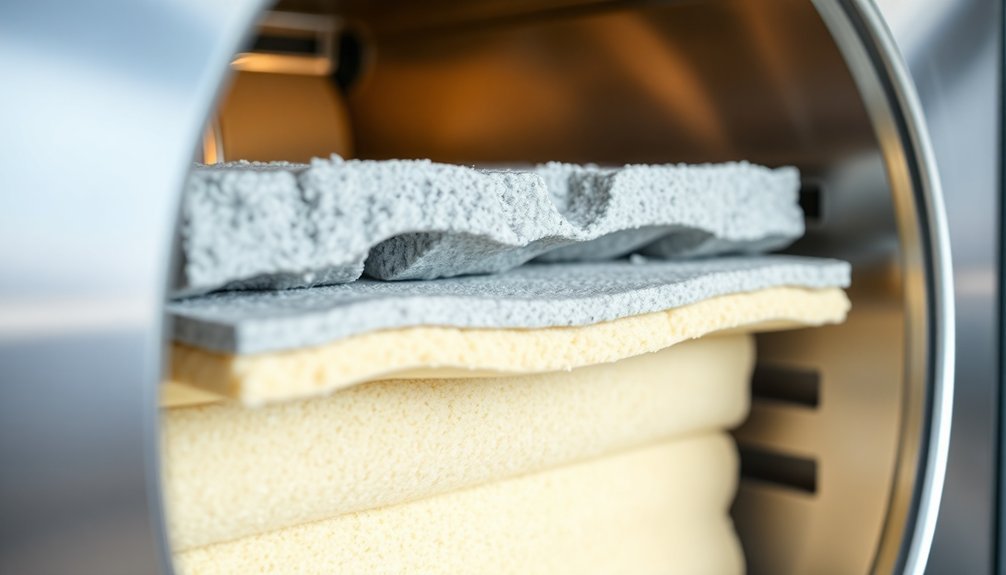
Three key elements define effective oven insulation: glass wool products, ceramic fiber materials, and specialized coatings.
Glass wool leads the way with its impressive heat resistance up to 550°C and its composition of 80% recycled glass. You'll find it's both cost-efficient and environmentally sound. Modern manufacturers focus on continuous material improvement to enhance both quality and productivity.
When it comes to construction, you'll want ceramic fiber blankets or lightweight insulating castable for your domed and arch roofs, with at least 2" thickness.
For the base layer between the structural foundation and oven floor, insulating fire bricks work better than ceramic boards.
Don't forget about Prosyneffex™ coatings like Nansulate™ EPX-H2O – they're durable and chemical-resistant, lasting over ten years.
The most effective design uses a three-layer structure with an air cavity, maximizing heat retention while minimizing thermal losses.
Door Sealing Mechanisms
When it comes to maintaining consistent baking temperatures, proper door sealing mechanisms serve as your oven's first line of defense against heat loss.
Spring-loaded door closers press the door firmly against the frame, ensuring uniform heat distribution and operational safety in your oven.
You'll find automatic locking systems equipped with flame detection sensors that engage within seconds if a fire occurs, preventing oxygen from fueling the flames.
For a simple DIY approach, you can use wet towels strategically placed around vents to minimize steam leakage, though you'll need to position them carefully to avoid interfering with essential mechanisms.
Gas ovens require special attention since their need to expel combustion gases makes maintaining proper door seals even more critical for temperature control.
Quality door closing mechanisms, like the Imperial 20160, are designed with high-temperature-resistant materials that maintain consistent performance over time, helping you achieve ideal baking conditions every time you use your oven.
Cavity Design Features
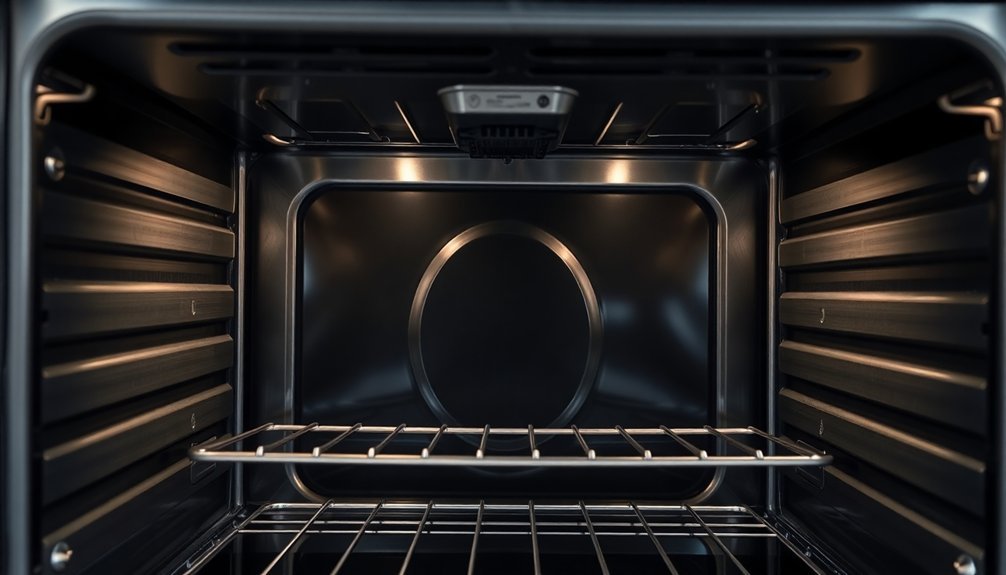
The inner workings of your oven's cavity play a pivotal role in its heat retention capabilities. When you peek inside, you'll notice the cavity walls are coated with enamel, which isn't just for looks. This special coating achieves an impressive emissivity rating of about 0.96, meaning it's highly effective at transferring heat from the walls to your food.
Your oven's cavity design incorporates both top and bottom heating elements that work together to maintain consistent temperatures. The energy is delivered in controlled ON/OFF cycles, ensuring proper heat storage throughout the cavity. The hidden bake tray beneath helps protect heating elements while maintaining optimal heat distribution.
Modern designs can boost thermal efficiency from 12% to 30% through advanced materials and smart placement of components. Plus, the cavity's construction minimizes thermal bridges – those pesky spots where heat might escape through connectors or fan openings.
Heat Distribution Systems
Building on the oven cavity's design, different heat distribution systems greatly impact how well your oven maintains its temperature.
You'll find various approaches to heat distribution across different oven types, each with unique benefits for temperature retention.
- Conventional ovens use dual heating elements that directly transfer heat, but they can create temperature variations without proper insulation.
- Convection ovens excel at maintaining consistent temperatures through forced air circulation, cooking food up to 25% faster while eliminating cold spots.
- AGA ovens leverage their all-metal construction to retain and distribute radiant heat evenly, though they're slower to reach temperature. The radiation stays contained inside these ovens, preventing excess heat from escaping into the kitchen.
- Microwave ovens generate heat within the food itself, but they're prone to uneven heating patterns despite using turntables or stirrers.
When looking for superior heat retention, convection and AGA systems typically offer the most consistent temperature control throughout the cooking process.
Air Flow Management
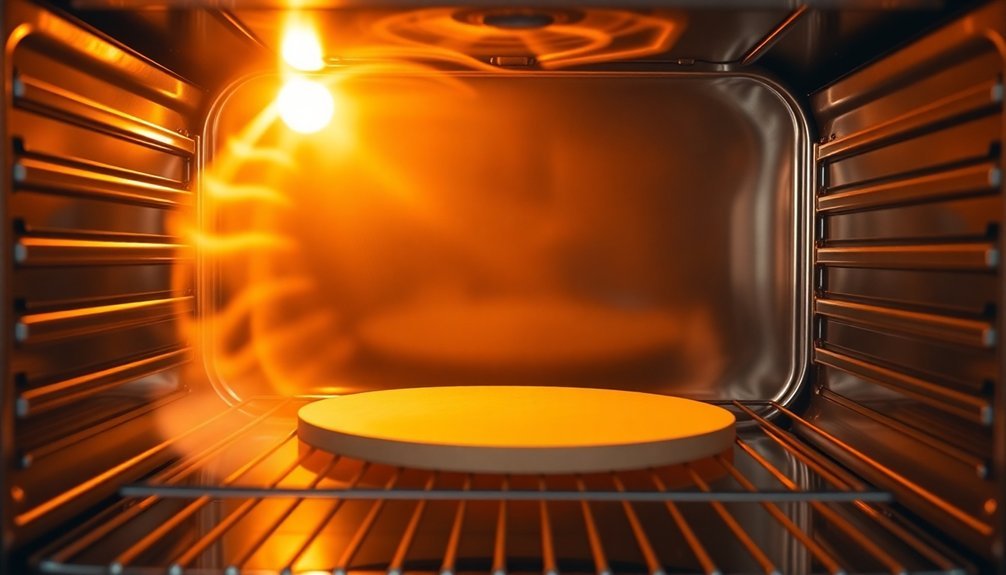
Managing airflow effectively stands as a critical factor in maintaining consistent oven temperatures and achieving ideal baking results.
You'll want to verify your oven's air vents are properly positioned to direct heat circulation uniformly throughout the baking space. This helps minimize temperature variations that can lead to uneven baking.
Pay attention to your oven's airflow direction, as it directly impacts heat transfer to your food. If you're using a convection oven, the mechanical fans will help distribute heat more evenly.
You can adjust the vents to create specific airflow patterns that suit your baking needs, whether you're making bread or delicate pastries.
Regular monitoring of your oven's airflow patterns will help you optimize baking times and maintain consistent results.
Consider using sensors to detect any irregularities in air pressure or distribution.
Temperature Control Methods
Beyond proper airflow, precise temperature control serves as the cornerstone of successful baking.
You'll want to start by using an oven thermometer to verify your oven's actual temperature against its settings. Once you've identified any discrepancies, calibrate your oven following the manufacturer's instructions to guarantee accuracy.
To maintain consistent heat while baking, you'll need to:
- Keep the oven door closed as much as possible to prevent heat loss
- Use high-quality, oven-safe cookware that conducts heat efficiently
- Place a baking stone on the lower rack to act as a heat sink
- Set convection ovens 25 degrees lower than conventional temperatures
Remember to rotate your baking sheets to combat hot spots, and utilize racks strategically for maximum heat circulation.
With proper temperature control, you'll achieve more consistent and reliable baking results.
Reflective Surface Technologies
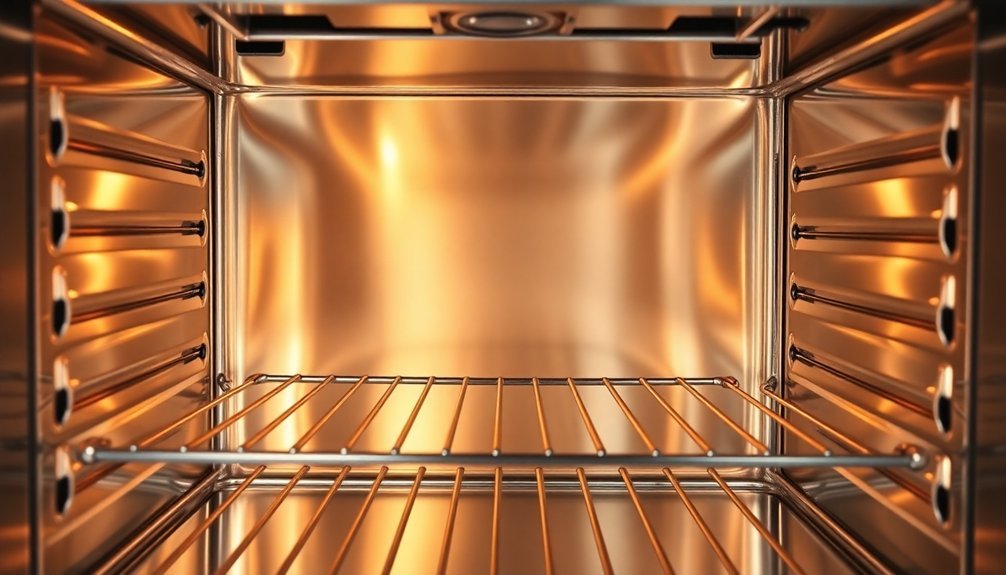
Modern ovens use advanced mirror-like coatings on their interior surfaces to maximize heat retention and improve baking efficiency.
You'll find these specialized ceramic coatings reflect infrared radiation back into the oven cavity, reducing energy waste by up to 20%.
The strategic design of reflective surfaces works alongside the oven's heat-reflective cavity to create an ideal environment where heat stays exactly where you need it – around your food.
Internal Mirror-Like Coatings
Internal mirror-like coatings represent a breakthrough in oven heat retention through high-emissivity ceramic materials that revolutionize energy efficiency.
These advanced coatings work by absorbing and redirecting heat back to your food as infrared radiation, reducing gas consumption and carbon emissions by up to 20%.
You'll find these innovative coatings can enhance your oven's performance in several ways:
- Save energy by requiring less fuel input while maintaining ideal baking temperatures
- Extend your oven's lifespan by minimizing direct heat exposure on surfaces
- Create a more stable baking environment through better heat distribution
- Install easily without production downtime, offering quick returns on investment
The versatile application allows you to upgrade existing ovens or incorporate the technology into new ones, making it an accessible solution for improving baking efficiency.
Heat-Reflective Cavity Design
Strategic placement of reflective surfaces within your oven's cavity dramatically improves heat distribution and energy efficiency.
You'll find aluminum is the most practical choice, reflecting about 80% of infrared energy while being cost-effective. Though gold offers superior reflection at 98%, it's rarely used due to cost constraints.
Your oven's cavity design should integrate composite materials with reflective layers to maximize heat retention.
When these surfaces stay clean and well-maintained, they'll direct radiant heat uniformly to your food, resulting in better baking results.
Look for ovens that combine high-emissivity coatings (like enamel) on cooking surfaces with reflective walls – this combination guarantees heat radiates effectively to your food while being contained within the cavity.
This design approach can boost thermal efficiency from 12% to 30%.
Thermal Mass Components
You'll find that heavy materials like cast iron and refractory concrete serve as excellent thermal mass components in ovens, storing energy for consistent heating during baking sessions.
The thickness of your oven's walls plays the most essential role in heat retention, with thicker walls providing superior thermal storage capacity.
When you combine multiple insulation layers with substantial thermal mass, you'll create an ideal heat-holding environment that maintains steady temperatures even when opening the oven door.
Heavy Materials Store Energy
While many factors contribute to an oven's performance, the thermal mass of heavy materials plays an essential role in heat retention and distribution.
You'll find that dense materials like brick, stone, and concrete excel at absorbing and storing heat energy, which they'll release slowly over time.
The most effective thermal mass materials for your oven include:
- Firebricks with high alumina content for superior heat absorption
- Dense concrete slabs that enhance heat conductivity
- Silica sand layers that act as heat reservoirs
- Traditional masonry components like brick and stone for consistent radiation
These materials work together to maintain steady temperatures during lengthy baking sessions.
When you're baking multiple pizzas or doing extended roasting, you'll appreciate how these heavy materials replenish lost heat and keep your oven performing consistently.
Wall Thickness Matters Most
The thickness of an oven's walls directly impacts its ability to maintain consistent temperatures and prevent heat loss. When you're baking, thicker walls provide better insulation and thermal mass, helping your oven bounce back quickly after door openings. You'll find that 4-inch walls work well for temperatures up to 450°F, though some ovens use thicker walls to handle high positive pressure from airflow.
| Wall Feature | Performance Impact |
|---|---|
| Thickness | Controls heat retention |
| Material | Affects transfer rate |
| Insulation | Reduces energy loss |
| Air Gap | Prevents heat escape |
| Thermal Break | Stabilizes temperature |
Your oven's wall construction isn't just about durability – it's vital for maintaining steady temperatures and protecting against external temperature fluctuations. The right combination of thickness and insulation will greatly improve your baking results while reducing energy consumption.
Multiple Insulation Layer Benefits
Building on proper wall construction, effective insulation layers work together with thermal mass components to create an ideal baking environment.
You'll find that combining ceramic fiber, calcium silicate, or perlite-cement mixes with proper thermal mass materials like silica sand and firebricks maximizes heat retention.
Your insulation strategy should include multiple layers, typically 2-4 inches deep, to trap air and reflect heat effectively.
This multi-layer approach works with thermal mass to:
- Lock in heat for extended baking sessions, allowing multiple pizza rounds
- Keep exterior temperatures low while maintaining intense interior heat
- Enable next-day baking without reheating
- Provide consistent temperatures throughout the cooking chamber
The combination of proper insulation and thermal mass means you'll spend less time reheating and more time baking perfect pizzas and bread.
Energy Loss Prevention
Modern ovens can lose significant energy through poor insulation and inefficient heating methods, but implementing the right prevention strategies makes a substantial difference.
You'll minimize energy waste by ensuring your oven has tight-fitting, dense mineral wool insulation, which can prevent 10-15% of typical energy loss.
To further reduce energy waste, you'll want to focus on proper heat management.
Consider using convection baking at lower temperatures (200-300 degrees) instead of high-temperature radiant heating.
You can also benefit from hybrid ovens that combine both heating methods for peak efficiency.
If you're looking to maximize savings, heat recovery systems can help you save an additional 15% on energy costs by capturing and reusing excess heat for water heating or air preheating processes.
Heat Transfer Enhancement
When maximizing heat transfer in ovens, you'll find three primary mechanisms working together: conduction through baking surfaces, convection via air circulation, and radiation from heating elements.
These systems work in harmony to maintain consistent temperatures and guarantee even baking results.
Modern ovens enhance heat transfer through advanced features that you can leverage for better baking:
- Fan-assisted convection that circulates hot air uniformly, reducing baking times and improving consistency
- Hybrid heating systems combining direct gas, convection, and radiant heat for ideal temperature control
- Multiple heating zones that allow for intense initial heat followed by gentler baking phases
- Smart zone technology that balances vertical heat distribution while managing color development and moisture
You'll get the best results when your oven effectively combines these heat transfer methods with proper airflow management.
Materials Selection Criteria
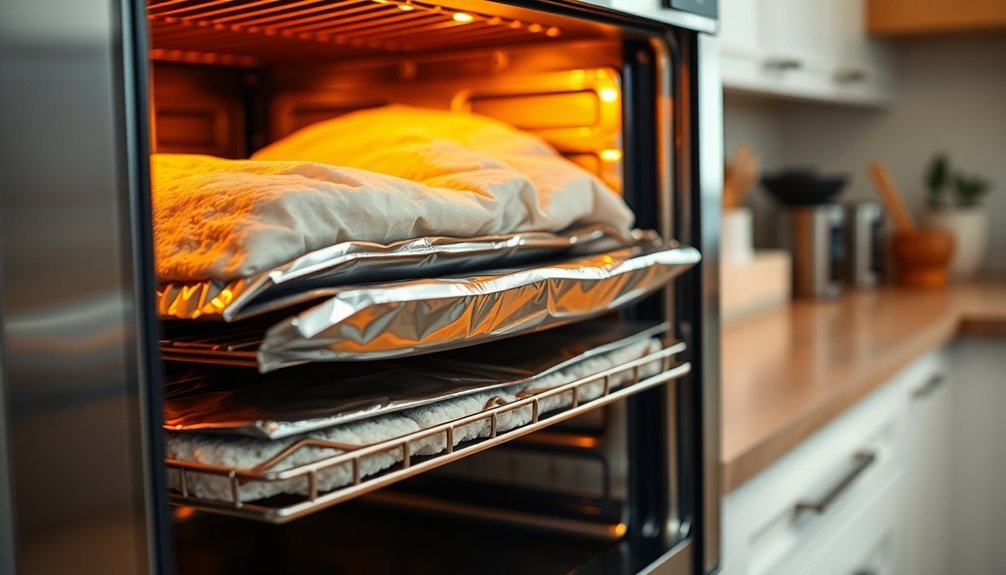
Selecting the right materials for your oven's construction plays a crucial role in heat retention and baking performance. You'll want to focus on materials that balance thermal conductivity with thermal mass. Refractory bricks and firebricks are excellent choices, as they combine high thermal mass with moderate heat conductivity, ensuring steady temperatures throughout your bake.
While steel offers rapid heat transfer, it won't retain heat as well as brick. You should consider using ceramic fiber materials for insulation, as they'll help maintain consistent temperatures while keeping the outer shell cool.
When choosing materials, you'll need to weigh cost against performance. Though refractory materials cost more than standard options, their durability and heat retention properties make them worth the investment, especially if you're seeking professional-quality results.
Structural Design Elements
Your oven's heat retention depends heavily on its multi-layer wall construction, which combines thermal mass materials with strategic insulation layers.
You'll find that selecting high-performance insulation materials like ceramic fiber and incorporating reflective barriers maximizes the oven's efficiency.
Proper door sealing mechanisms, including heat-resistant gaskets and tight-fitting designs, prevent heat from escaping and maintain consistent internal temperatures.
Multi-Layer Wall Construction
Modern baking ovens rely on sophisticated multi-layer wall construction to maximize heat retention and energy efficiency. The key to this design is a three-layer system that combines insulating materials with a metallic sheet, working together to trap and reflect heat effectively.
- The first insulating layer sits directly against the cavity wall, reducing heat conduction and providing flexible adaptation to the oven's interior surface.
- A metallic sheet layer efficiently reflects thermal radiation back into the oven cavity, preventing heat loss.
- The outer insulating layer adds mechanical stability and further heat retention capabilities.
- Multiple sub-layers are woven together to eliminate gaps and create a unified insulation barrier.
You'll find this multi-layer approach particularly effective because it addresses all forms of heat transfer – conduction, convection, and radiation – while maintaining structural integrity during the baking process.
Insulation Material Selection
Building on the multi-layer wall design, the choice of insulation materials shapes an oven's heat retention capabilities. You'll want to select materials based on your oven's operating temperature and construction type. Ceramic fiber blankets offer superior performance for most builds, handling temperatures up to 1260°C while taking up minimal space.
| Material | Max Temp | Best Use Case |
|---|---|---|
| Ceramic Fiber | 1260°C | Long-duration baking |
| Rockwool | 1000°C | Permanent installations |
| Fiberglass | 538°C | Multiple oven builds |
For floor insulation, you can't go wrong with calcium silicate boards, which maintain heat for 4+ hours without extra fuel. If you're building multiple ovens, fiberglass provides a cost-effective solution, though you'll need double layers for peak performance. Remember that proper insulation can reduce your energy consumption by up to 4.5%.
Door Sealing Mechanisms
While the perfect insulation material matters greatly, a well-designed door sealing mechanism proves equally essential for ideal heat retention.
You'll find that high-quality door sealing systems, like those in the Imperial IR6G24 models, use specialized spring structures and OEM components to maintain consistent pressure against the door frame.
- Spring mechanisms keep the door firmly pressed against the frame, creating an airtight seal
- Properly aligned frames and mechanisms prevent unwanted heat escape
- Thermal expansion joints help maintain the seal during temperature changes
- Companion flanges and gasket systems guarantee durability through repeated heating cycles
Your oven's ability to maintain uniform temperatures depends heavily on these sealing mechanisms.
When functioning correctly, they'll prevent heat loss, reduce energy consumption, and help you achieve consistent baking results every time you use your oven.
Frequently Asked Questions
How Long Should an Oven Be Preheated for Optimal Heat Retention?
You'll want to preheat your oven for 15-25 minutes depending on your target temperature. For 350°F, allow 15 minutes, and add 5 minutes for each additional 50°F to guarantee ideal heat retention.
Does the Color of Oven Walls Affect Heat Distribution?
Yes, your oven's wall color affects heat distribution. Dark walls have higher emissivity, transferring heat more efficiently through radiation. You'll get better heat distribution with darker surfaces compared to lighter ones when baking.
How Do Power Outages Affect Heat Retention in Different Oven Types?
During a power outage, your gas oven will retain heat and continue working with manual lighting, while your electric oven will immediately stop working and lose heat, regardless of how well it's insulated.
Can Adding Water to the Oven Floor Damage Heating Elements?
You shouldn't add water directly to your oven floor as it can damage heating elements. While steam is beneficial for baking, use proper steam methods like a water pan or dedicated steam function instead.
Why Do Some Ovens Take Longer to Cool Down Than Others?
Your oven's cooling time depends on its insulation quality, construction materials, and thermal mass. If it's built with heat-retaining materials like brick or stone and has good insulation, it'll naturally cool down slower.
In Summary
You'll find your oven retains heat best when it combines several key elements: proper insulation materials, tight door seals, and efficient cavity design. Make sure you're maintaining the door gaskets and keeping the seals clean. Consider that your oven's heat retention depends heavily on its construction quality and materials. By understanding these factors, you'll achieve better baking results and improved energy efficiency.